The easiest screen-free break is one with a few ready-to-go activities and a rough plan: a puzzle or two that a child can start alone, a game the whole family can join, and one short challenge to finish the day on. Everything below needs only paper, a pencil and, for chess, a board. Several of the activities link to free printable pages on this site.
School holidays are long, and "find something to do" is a hard job for a child at 10 a.m. on the third day. The fix is not a bigger list but a smaller, better-chosen one. Pick a couple from each group below, keep them where children can find them, and let the plan do the work.
Which Sudoku suits a younger child?
Start with the smallest grid your child can finish. A 4x4 Sudoku uses only the numbers 1 to 4, needs no reading and fits on half a page. Our guide to what age children can start Sudoku explains the progression from 4x4 to 6x6 to 9x9, and how to solve a 4x4 Sudoku has a worked example and three free printable practice puzzles with answers.
A simple routine for the first puzzle: sit beside them, ask "which number is missing from this row?", and then step back. When a 4x4 stops being a challenge, move up a grid size rather than waiting for a birthday.
What geography and flag activities can you do on paper?
Maps and flags work well at a kitchen table because the answer is on the page, so no adult has to be the quiz master. Three free printables on this site:
- the 50 states map quiz: a numbered blank US map, capitals matching and an answer key
- the flag matching worksheet: match 12 flags to their countries, then learn five look-alike pairs
- the geography quiz for kids: 30 questions in three levels, plus a map round
For a flag challenge with no printing, how to teach kids world flags groups flags into families so a child can guess an unfamiliar one. And geography puzzles for kids has five original brain teasers (ages 8 to 12) that can be read aloud.
Are chess puzzles a good break activity?
They are, for a child who already knows how the pieces move. A chess puzzle is a position with a question: "White to move: find the checkmate." One puzzle takes a minute or two, which suits a short gap in the day.
The free chess puzzles for kids printable has ten beginner puzzles with diagrams and explained answers. If the pieces are still new, play a few games first and come back to puzzles afterwards. The mate-in-one chess puzzles article is a gentle first step.
How do you play logic and deduction games without a screen?
Logic puzzles give the same pleasure as a mystery: the facts are all there, and the answer appears when you put them together. The simplest form is a short list of clues and an arrangement to work out. You can try this approach in the Snow-Day Schedule puzzle below. For a longer version, how to solve a logic grid puzzle walks through the method step by step.
Older children and teens who like this can try the cases in The Detective's Logic Casebook, which is written for adults and teens, not young children.
What family trivia can you play at the table?
Trivia needs no equipment, and mixed ages can play together if the questions are mixed. Two ready-made sets on this site:
- 50 states quiz for kids: 20 questions with answers, meant to be asked aloud
- American history trivia for kids and families: easy and harder questions in one set
Give each player a turn as quiz master. Reading the question and checking the answer is a skill too, and it keeps a child engaged when it is not their turn to answer.
Try an original puzzle: the Snow-Day Schedule
Here is a short logic puzzle written for this page. It has four short clues and needs no maths, so a child who can read them can try it, and a younger one can work it out with you.
Four children are planning four winter-break days, Monday to Thursday. They will do one activity a day: cookie baking, fort building, game night and puzzle day. Each activity happens on a different day. Work out which activity goes on which day.
The clues
- Game night is the day right after fort building.
- Puzzle day is earlier in the week than cookie baking.
- The fort is not built on Tuesday.
- Game night is not on Thursday.
| Monday | Tuesday | Wednesday | Thursday |
|---|---|---|---|
Prints the puzzle only, without the answer.
Write one activity in each box of the grid. Use the "Print this puzzle" button to print the clues and grid on their own, without the answer.
A hint if you need one: clue 1 ties fort building and game night together, so they must sit on two days in a row. List the pairs of days they could take, then let clues 3 and 4 cross some of them out.
Stop here and try it before reading on.
Answer to the Snow-Day Schedule
Monday: fort building. Tuesday: game night. Wednesday: puzzle day. Thursday: cookie baking.
Why: by clue 1, fort building and game night are on consecutive days. The pairs that fit are Monday-Tuesday, Tuesday-Wednesday and Wednesday-Thursday. Clue 3 rules out the fort on Tuesday, which removes the second pair. Clue 4 rules out game night on Thursday, which removes the third. That leaves fort building on Monday and game night on Tuesday. Puzzle day and cookie baking share Wednesday and Thursday, and clue 2 puts puzzle day first. Checking all four clues against the answer: each one holds.
How do you choose activities by age and difficulty?
Choose by what the child can already do, not by their age alone. The table gives a sensible place to start and a sign that it is time to move up.
| Activity | A good starting point | Move on when |
|---|---|---|
| Sudoku | 4x4 grid, a few numbers missing | they finish one without help |
| Flags and maps | matching 12 flags, then the map quiz | matching is quick and accurate |
| Chess puzzles | after they can play a legal game | mate in one is easy |
| Logic puzzles | 3 or 4 clues, one category | they can explain each step aloud |
| Trivia | mixed-age questions at the table | they want to write their own |
If a child gets stuck, make it smaller rather than giving the answer: fewer missing numbers, fewer flags, a hint. The aim is a task that is a little hard, not one that ends the activity.
Which MindGrid Books go with these activities?
If your child enjoys a printable and wants more, three of our books follow on directly:
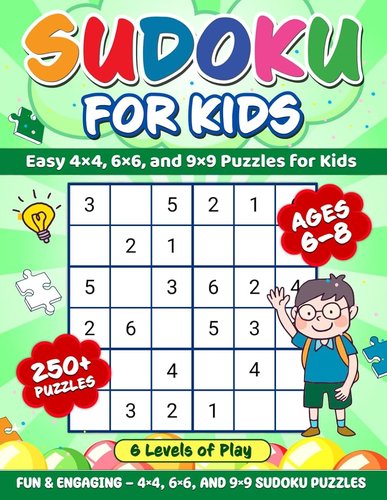
- Sudoku for Kids Ages 6-8: easy and medium puzzles, growing from 4x4 grids up to 9x9
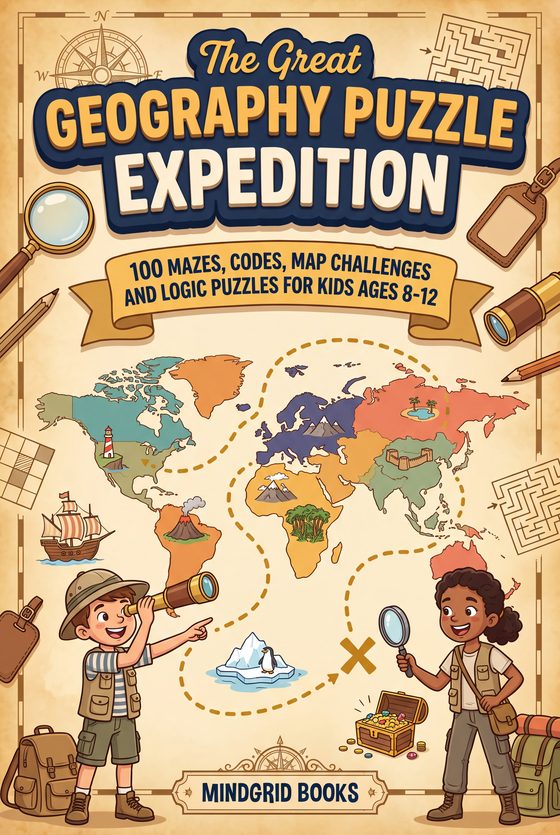
- The Great Geography Puzzle Expedition: 100 geography puzzles for ages 8 to 12, each with a hint and an explained answer
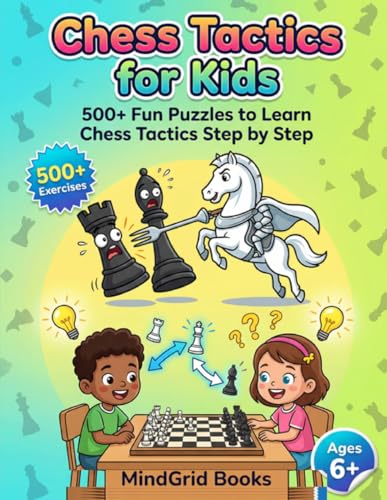
- Chess Tactics for Kids: 504 puzzles from real games, with large diagrams and full solutions
You do not need any of them to use the free pages above. If you are choosing a present instead, our puzzle book gift ideas by age compare every children's title we publish, from first 4x4 Sudoku grids to logic mysteries for teens.
A four-day winter break plan
Swap the days freely. Each day has one short activity from the list above, and the rest of the day is open.
| Day | Main activity | Where to find it |
|---|---|---|
| Day 1 | A map and flag morning | Flag matching worksheet |
| Day 2 | Family trivia at the table | 50 states quiz |
| Day 3 | Sudoku practice, then a logic puzzle | 4x4 Sudoku practice |
| Day 4 | Chess puzzles, then a game | Chess puzzles for kids |
Keep each activity short. Fifteen to twenty minutes is a reasonable first try, and stopping while a child is still interested leaves them wanting to come back to it.