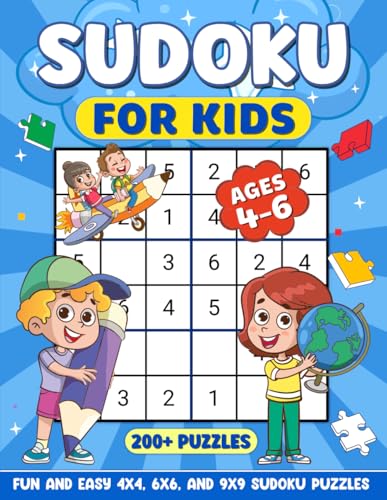
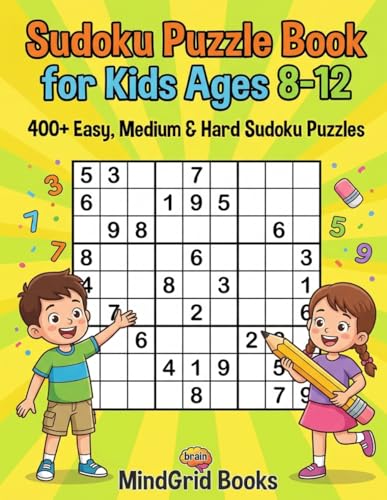
Start with a 4x4 grid that uses the numbers 1 to 4: plenty of children manage one at around four or five. A 6x6 grid usually suits children of about six to eight, and the full 9x9 grid about eight and up. Grid size matters more than age: start on the smallest grid a child can finish, and move up when it stops holding their interest.
Parents usually ask this question the wrong way round. The question is not "how old does a child have to be for Sudoku?" but "which size of Sudoku is this child ready for?" Those are very different questions, and the second one has a much more encouraging answer.
A four-year-old cannot do a 9x9 Sudoku. A four-year-old can very often do a 4x4 Sudoku on their second or third attempt. Same puzzle type, same logic, same satisfaction at the end — just a grid small enough that the whole thing fits in a child's working memory at once.
Why does Sudoku suit young children?
Because it needs no reading, no arithmetic and no prior knowledge — only the habit of checking a row, a column and a box before writing a number.
Sudoku has a reputation as an adult puzzle, which puts parents off trying it early. But look at what it actually asks of a solver:
- No reading. Not one word.
- No arithmetic. The numbers are labels, not quantities. You never add anything. A 4x4 grid works exactly as well with four animal stickers.
- No general knowledge. Nothing has to be known in advance.
- Clear rules. Every row, column and box must hold each number once, so a child can check a finished grid themselves.
That last point is the one that matters most. Sudoku is self-marking. A child who has filled the grid can see that every row, column and box is complete, without an adult telling them they were right. Very few activities for a five-year-old offer that.
What it does require is the one skill it is actually training: holding two constraints in mind at the same time. This number cannot go here because of the row, and also cannot go there because of the box. That is deduction, and it is the whole point.
Which Sudoku grid size suits which age?
Start at 4x4, move to 6x6, then 9x9. The ages are rough; the size of grid a child can finish is the better guide, and it is the part that determines success or frustration.
| Grid | Numbers used | Cells | Box shape | Roughly suits |
|---|---|---|---|---|
| 4x4 | 1–4 | 16 | 2x2 square | ages 4–6 |
| 6x6 | 1–6 | 36 | 2 tall, 3 wide | ages 6–8 |
| 9x9 | 1–9 | 81 | 3x3 square | ages 8–12 and up |
4x4 (ages roughly 4–6). Four rows, four columns, four boxes of four cells, using the numbers 1–4. Typically five or six cells are already filled. Most children solve these by pure elimination — "this row already has 1, 2 and 4, so this one has to be 3" — which is exactly the reasoning a 9x9 needs later. Some books use shapes or colours instead of numbers at this size, which is fine and sometimes better for a pre-reader.
6x6 (ages roughly 6–8). Six rows and columns, with boxes that are 2 tall and 3 wide. This is the step that surprises people. The jump from 4x4 to 6x6 is much larger than it sounds, because the boxes are no longer square, so a child has to look at a rectangle of six cells rather than a tidy corner. This is the size where children start scanning the whole grid instead of one cell at a time. 4x4 vs 6x6 Sudoku for kids covers that step in detail.
9x9 (ages roughly 8–12). The standard adult grid. The technique is the same as an adult's; what should differ is how much help the grid gives — more of its numbers already filled in, and a gentler route to the first move. The number of starting clues is only a rough guide to difficulty, though, as Sudoku difficulty levels explained shows. The patience required is the real difference.
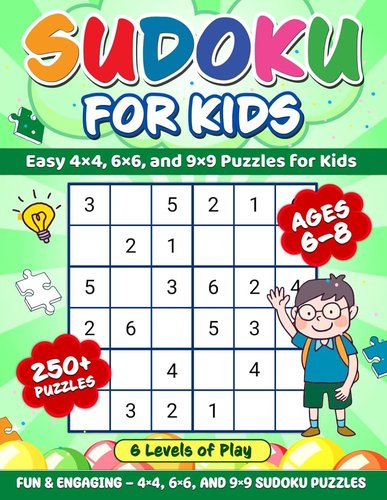 Available on Amazon
Sudoku for Kids Ages 6-8
250+ easy and medium puzzles across 6 levels of play, growing from 4×4 grids all the way up to full 9×9.
Learn more →The ages above are a rough guide and nothing more. Plenty of six-year-olds are still happiest on 4x4, and plenty of five-year-olds are ready for 6x6. The grid size is the real variable; age is only a proxy for it.
How do you teach a child their first Sudoku?
Skip the rules. Point at a row, column or box that has three of its four numbers filled in and ask which one is missing.
Sit next to the child, not opposite. Take a 4x4 grid and find the row, column or box that already has three of its four cells filled. There is almost always one.
Point at it and ask: "which numbers are already here?" Let them read them out. Then: "so which one is missing?" They will tell you. Then they write it in.
That is the entire lesson. Do not explain the rules first. The rule — every row, every column and every box holds each number exactly once — makes far more sense after they have used it once than before.
Then find the next nearly-complete line and do it again. By the third or fourth cell most children will have stopped waiting for you to point.
How to solve a 4x4 Sudoku walks through a complete first puzzle step by step, with three practice grids to print, and how to teach Sudoku to kids covers what to say when a child gets stuck.
What makes a child give up on Sudoku?
Usually something the adult does: starting on a grid that is too big, allowing guesses, helping too soon, timing, or correcting mid-puzzle.
Starting on a grid that is too big. By far the most common. A child who stalls on a 9x9 concludes they are bad at puzzles. A child who finishes a 4x4 concludes they are good at them. The second child will still be doing Sudoku next year.
Letting them guess. Guessing feels like progress and is the enemy of the whole exercise. If a child cannot see the next move, the answer is not to guess — it is to look at a different row. Say "let's find an easier one first" rather than "try one and see."
Helping too quickly. The pause before a child spots the answer is not a problem to be solved. It is the activity. Count to twenty in your head before saying anything.
Timing them. Speed is an adult's way of enjoying Sudoku. For a child it converts a calm puzzle into a test, and it rewards guessing.
Correcting mid-puzzle. If they put a number in the wrong cell, let them continue until the contradiction appears on its own. Finding your own mistake is a more useful lesson than being told about it, and the puzzle will always produce one.
What should you look for in a children's Sudoku book?
- One grid size per book, or a clearly marked progression. A book that mixes 4x4 and 9x9 randomly will strand a child halfway through.
- Large grids on the page. Small children write large numbers. A grid that fits four to a page is usually too small to write in comfortably.
- A generous number of starting clues. "Easy" in a children's book should mean genuinely easy, not an adult easy.
- A full answer key. Not for the child — for you, at the point where they are stuck and you cannot see it either.
- Puzzles meant to be solved by logic. Standard published puzzles are generally designed to have one solution, reached by deduction. If a grid ever seems to need a guess, move to another puzzle rather than teaching guessing.
Our four children's books, and the grid sizes each one covers, are compared side by side on the sudoku books page. If the book is a present, the gift guide to puzzle books for kids sets them beside our geography, chess and logic titles by age.
When should a child move up to a bigger grid?
Move up when the current size has stopped being interesting rather than when it has become easy. A child who finishes a 4x4 in under a minute and asks for another one is ready. A child who finishes it in under a minute and puts the book down was ready a while ago.
Going up a size will slow them down dramatically, and that is expected. It is worth saying out loud beforehand: "these are bigger, so they take longer — that is supposed to happen." Otherwise the slowdown reads as failure.
Questions parents ask
Is Sudoku good for kids?
It is a screen-free logic activity that checks its own answers and rewards patience over speed. Claims that it raises children's IQ are not supported by research; the benefits of Sudoku for kids looks at what the evidence does and does not show.
Can a 3-year-old do Sudoku?
Some three-year-olds can manage a 4x4 grid with an adult beside them, particularly a picture or colour version. If it causes frustration, put it away for a few months; nothing is lost by waiting.
Is a 9x9 Sudoku too hard for a 7-year-old?
Not always. A seven-year-old who finishes 6x6 grids comfortably is ready to try an easy 9x9. One who has not met 6x6 yet will find the jump easier after it.
How long should a young child's Sudoku session be?
Short. A few puzzles, stopping while the child still wants another, works better than a long sitting. For a 4x4 grid that can be five minutes.
Should children use a pencil or a pen?
A pencil with an eraser. A child who spots their own mistake needs to be able to fix it cleanly, and a crossed-out grid is much harder to read.
Key takeaways
- A 4x4 grid using the numbers 1 to 4 is the place to start; many children can finish one at four or five.
- The usual order is 4x4, then 6x6, then 9x9. The grid a child can finish is a better guide than their age.
- The first lesson needs no rules: find a line with three of its four numbers and ask what is missing.
- Starting too big, guessing, timing and helping too quickly are the habits that make children give up.
- Move up a size when the current one stops being interesting, and say in advance that bigger grids take longer.