Start with 4x4 and move to 6x6 once a child finishes 4x4 grids quickly and asks for more. The rules are identical at both sizes. What changes is the box: a 4x4 grid has four 2x2 square boxes, while a 6x6 grid has six rectangular boxes, 2 cells tall and 3 wide, and learning to see those rectangles is most of the step.
On paper the difference looks trivial. A 4x4 Sudoku uses the numbers 1 to 4 in sixteen squares. A 6x6 uses 1 to 6 in thirty-six. Two more numbers, twenty more squares, same rules.
In practice the step is larger than that, and for a reason most parents do not spot until they watch a child hit it: the box stops being a square. That one change is the whole difficulty of 6x6, and knowing about it in advance makes the transition much smoother.
What changes between 4x4 and 6x6 Sudoku?
The rules stay the same; the grid grows and the box changes shape. Here is the comparison, with the full 9x9 grid for reference:
| 4x4 | 6x6 | 9x9 | |
|---|---|---|---|
| Numbers used | 1–4 | 1–6 | 1–9 |
| Cells | 16 | 36 | 81 |
| Boxes | four 2x2 squares | six rectangles, 2 tall and 3 wide | nine 3x3 squares |
| Possible numbers for an empty cell | up to 4 | up to 6 | up to 9 |
| What the stage teaches | the rule, and the habit of finishing | that a box is wherever the lines say it is | the full game |
In a 4x4 grid the four boxes are 2x2. They are squares, they sit in the corners, and a child can see them without being told where they are. The grid looks like four little grids, because it is.
In a 6x6 grid the six boxes are rectangles — three wide and two tall. There is no other way to do it: a 6x6 grid has to be split into six boxes of six cells each, and six cells cannot make a square. So the boxes no longer line up with the shape of the grid, and a child who has only ever solved 4x4 puzzles will keep scanning the wrong region.
This is why the first few 6x6 puzzles often go badly for a child who was breezing through 4x4 grids. It is not that the puzzle is much harder. It is that they are looking at the wrong box, and nobody mentioned that the boxes had changed shape.
How do you prepare a child for their first 6x6 puzzle?
It takes about thirty seconds. Before the first 6x6 puzzle, trace the six boxes with a finger. Say out loud that the boxes are wide now, not square, and that each one still needs all six numbers exactly once. That is the entire briefing.
Some children benefit from lightly outlining the boxes in colour on the first two or three puzzles. The printed grid lines already mark them, but a child whose eye is trained on 2x2 squares often needs the boundary made louder before it takes.
Why start at 4x4 at all?
It would be reasonable to ask why not just start at 6x6 and skip the re-learning. The answer is that 4x4 does a different job.
A 4x4 puzzle can be finished in about two minutes. That matters more than it sounds. A child who completes a puzzle quickly wants another one immediately; a child who stares at a grid for twenty minutes usually closes the book. The 4x4 stage exists to establish the rule and the habit of finishing, not to be intellectually demanding.
It also teaches the one thing that transfers completely: the scan. No number twice in a row, no number twice in a column, no number twice in a box. That logic is identical at every grid size, and a child who has internalised it on sixteen squares carries it straight to thirty-six. How to solve a 4x4 Sudoku shows that method on a complete worked example.
How do you know a child is ready for 6x6?
The signal is boredom, not mastery. Specifically:
- They finish a 4x4 in a minute or two without hesitating
- They stop asking for help
- They start filling cells in whatever order they spot them, rather than working left to right
- They finish one and ask for another
The last is the strongest. A child who wants a second puzzle has capacity to spare. A child who finishes quickly and puts the book down was ready some time ago.
What is not a signal is age. Children arrive at this at different points, and a confident five-year-old and a cautious seven-year-old can be in the same place. The grid size is a better guide than the birthday.
Warn them it will be slower
This is the single most useful thing to say before the switch: these are bigger, so they take longer, and that is supposed to happen.
Without that, the slowdown reads as failure. A child who was finishing puzzles in ninety seconds and now takes eight minutes will often conclude they have got worse. Naming it in advance turns the same experience into evidence that they have moved up. If they do stall, the hint ladder in how to teach Sudoku to kids gets them moving again without giving away a number.
 Available on Amazon
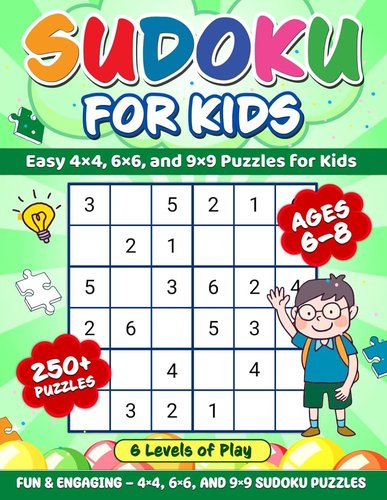
Sudoku for Kids Ages 6-8
250+ easy and medium puzzles across 6 levels of play, growing from 4×4 grids all the way up to full 9×9.
Learn more →Why not go straight to 9x9?
Because 6x6 is doing real work as a bridge, and it is doing it cheaply.
A 9x9 grid asks a child to hold nine candidates in mind per cell instead of four, across eighty-one squares. That is a substantial jump in working memory, and it lands much better once the child has already absorbed the awkward part — that the box is a region defined by lines on the page, not by the shape it happens to make.
Once a child is comfortable on 6x6, the 3x3 boxes of a full 9x9 grid are almost a relief. They are square again. From there, difficulty stops being about grid size and starts being about technique, which is what separates the Sudoku difficulty levels printed on adult books.
Which MindGrid Sudoku books cover 4x4 and 6x6?
All four of our children's Sudoku books contain more than one grid size. What differs is the balance.
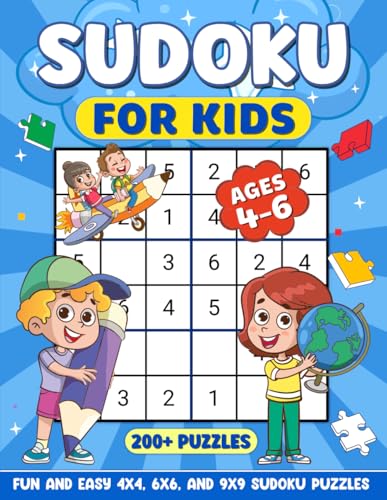
Sudoku for Kids 4-6 opens on 4x4 grids and spends most of its roughly 200 puzzles there before moving to 6x6 and eventually 9x9. It is the one to buy if the 4x4 stage has not happened yet.
Sudoku for Kids Ages 6-8 runs 250+ puzzles across six levels of play, from 4x4 up to 9x9, staying in easy and medium difficulty throughout. It covers the transition this article is about more deliberately than the others.
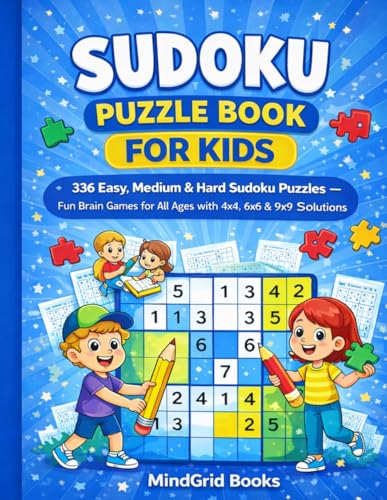
Sudoku Puzzle Book for Kids splits 336 puzzles almost evenly — 120 4x4, 108 6x6 and 108 9x9 — with each size running easy to hard. It is the widest single book, and the one that lasts longest through the transition.
Sudoku for Kids Ages 8-12 is weighted the other way, with 234 of its 400+ puzzles at full 9x9. Buy that one after the bridge, not during it.
If you are choosing between them, the sudoku books page lays out all ten side by side, and what age can kids start sudoku covers the stage before this one.
Frequently asked questions
Do 6x6 Sudoku boxes always run 3 wide and 2 tall?
Almost always. Some puzzles turn the boxes the other way, 2 wide and 3 tall. The rule does not change, so check which way the thick lines run before starting.
Is there a 5x5 Sudoku?
Not in the standard form. Twenty-five cells cannot be split into five equal rectangular boxes, so 5x5 puzzles use irregular regions instead, often sold as "jigsaw" Sudoku. That is why the usual progression for children goes from 4x4 straight to 6x6.
How can I make a 6x6 Sudoku easier for a child?
Outline the six boxes in colour, choose puzzles with more numbers already filled in, and have the child complete any row, column or box that is one number short before looking anywhere else.
What age is 6x6 Sudoku for?
Roughly six to eight, but how a child handles 4x4 grids is a better guide than their age. What age can kids start Sudoku sets out the whole progression.
Key takeaways
4x4 teaches the rule. 6x6 teaches that the box is wherever the lines say it is. 9x9 is the real game, and it is much easier to reach with the middle step than without it.
- 4x4 and 6x6 Sudoku follow the same rule; only the grid size and the box shape change.
- 4x4 boxes are 2x2 squares; 6x6 boxes are rectangles, 2 cells tall and 3 wide. Tracing them once before the first 6x6 puzzle prevents most early mistakes.
- Move up when a child finishes 4x4 grids quickly and asks for another, not at a set birthday.
- Expect 6x6 puzzles to take several times longer, and say so beforehand so the slowdown does not read as failure.
- Skipping 6x6 is possible, but it puts both lessons on the child at once, and the one that trips them up is the quiet one about box shape.