Explain the rule in one sentence, then spend the first few weeks teaching the scan: rows first, then columns, then boxes, each time looking for the fullest one. When a child is stuck, give hints that point to a region, never to a number. Keep sessions to ten or fifteen minutes, let mistakes surface on their own where you can, and step back as the child starts working alone.
Almost everyone teaching a child Sudoku starts by explaining the rule. Every row, every column and every box holds each number exactly once. It takes ten seconds, the child nods, and then they sit in front of the grid and do nothing.
The rule was never the hard part. A five-year-old can repeat it back immediately. What they cannot do is look — and that is the thing that actually has to be taught.
This article is about the weeks after the first puzzle: what to coach, what to say when a child is stuck, and how to stop being needed. If you are earlier than that, what age can kids start sudoku has the first-lesson script and the age question, and it lists the mistakes that make it go badly — this piece assumes you have got past that point.
Teach the scan, not the rule
A child staring blankly at a grid is not failing to understand Sudoku. They are failing to know where to point their eyes. Adults do this without noticing: we sweep for the fullest row, the fullest column, the fullest box, and we do it so automatically that it never occurs to us to say it out loud.
So say it out loud. Give the search a name and a fixed order:
Rows first. Then columns. Then boxes. Find the fullest one.
Then have the child narrate it while they do it. "Row one has two. Row two has three — that one." The narration feels laborious for about a week and then goes silent and internal, which is exactly what you want. You are installing a procedure, and procedures get installed out loud before they run quietly.
This single change is the difference between a child who needs you present and a child who works alone. Everything else in this article is detail.
What should you say when a child is stuck?
Work down a hint ladder, one rung at a time, that narrows where to look without ever naming a number or a cell.
The hardest moment in teaching Sudoku is the stuck one, because the obvious help — pointing at a cell and saying "that's a 3" — ends the puzzle for them.
Use a fixed ladder instead, and go down it one rung at a time, waiting properly between rungs:
| Rung | What you say | What it gives away |
|---|---|---|
| 1 | "Find the fullest row." | Nothing. It restarts the scan, and it is usually enough on its own |
| 2 | "Is there a line with only one empty square?" | Which kind of line to look for; still their discovery |
| 3 | "Look at this box." | The region, but not the cell |
| 4 | "What numbers are already in this box?" | The facts to reason from; the missing one usually announces itself |
| 5 | "Which number is missing?" | Everything short of the answer, and you will rarely need it |
Notice that no rung names a number or a cell. The child still makes every actual move. Rung one is doing almost all the work, and its whole content is go back to the routine — which is why teaching the routine matters so much.
How long should a Sudoku session be?
Stop while they still want another one.
A child who does four puzzles and is asked to stop will open the book again tomorrow. A child who does eleven and grinds to a halt on the twelfth has learned that the book ends in frustration. Ten or fifteen minutes is a good session at the start, and it is fine if that means three puzzles.
This matters more than daily practice. Sudoku is not a subject with a syllabus to get through — the only thing that has to happen is that the child keeps choosing it. Two enthusiastic sessions a week beat seven dutiful ones.
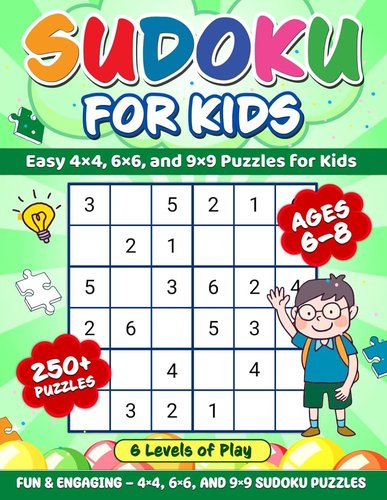 Available on Amazon
Sudoku for Kids Ages 6-8
250+ easy and medium puzzles across 6 levels of play, growing from 4×4 grids all the way up to full 9×9.
Learn more →Should you correct a child's mistakes straight away?
Usually not. Let the puzzle show the mistake, and step in only when it is buried deep.
When a child writes a number in the wrong cell, the instinct is to catch it immediately. Resist it, within reason.
A wrong number in a Sudoku usually produces a visible contradiction eventually — the same digit twice in a line, or a cell with nothing that can go in it. When the child hits that themselves and traces it back, they learn something no correction teaches: that the puzzle checks itself, and that being stuck is information rather than failure.
The exception is timing. If the mistake happened four moves ago, let it run. If it happened fifteen moves ago and the whole page is now built on it, step in — unpicking half a grid is demoralising and teaches nothing extra.
Either way, when it surfaces, say what it means: the grid is telling you something is wrong further back. That framing turns an error into a tool.
How do you know a child is making progress?
Parents tend to watch for speed. Speed is the least informative signal. Watch for these instead, roughly in the order they appear:
- They stop asking where to look. The scan has gone internal. This is the big one.
- They pause before writing. Early on children write the moment they have a candidate. Checking all three regions first is a real step forward.
- They self-correct without prompting. They spot their own duplicate and fix it silently.
- They ask for a harder one. The clearest signal of all, and it usually arrives before you think they are ready.
None of those are about time taken. A child who solves slowly and never guesses is in far better shape than one who is fast and lucky.
Aim to become unnecessary
The goal is not to teach Sudoku well. It is to reach the point where a child takes the book somewhere else in the house and you find out later that they did six.
Practically, that means shrinking your role deliberately: sit beside them for the first sessions, then across the room and available, then in another room entirely. Handing over the answer key is part of it too — a child who can check their own page does not need you for the last thing they needed you for.
Which book should you teach from?
The grid size matters more than the age printed on the cover.
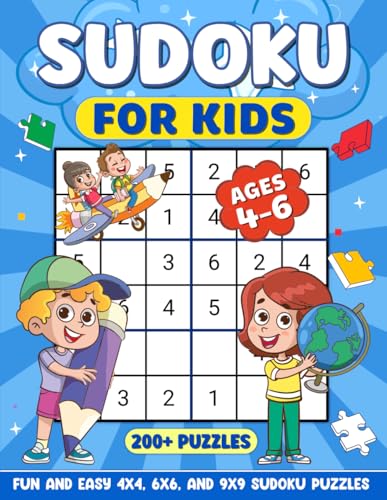
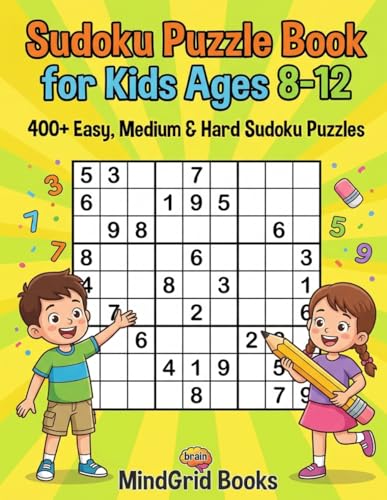
Sudoku for Kids 4-6 opens on 4x4 grids and stays there long enough for the scan to become a habit, which makes it the easiest book to teach from. Sudoku for Kids Ages 6-8 runs six levels from 4x4 to 9x9 and handles the step-ups more deliberately. Sudoku Puzzle Book for Kids splits 336 puzzles across three grid sizes, and Sudoku for Kids Ages 8-12 is weighted to full 9x9 for a child already past the bridge. The sudoku books page compares all ten.
For the mechanics of the smallest grids, how to solve a 4x4 sudoku sets out the method, and 4x4 vs 6x6 sudoku for kids covers the transition that follows.
Common teaching questions
What if my child's finished grid does not match the answer key?
Check the rows, columns and boxes. If every one holds each number exactly once, the grid is a correct solution: some puzzles allow more than one, and an answer key can show only one of them.
Can I teach Sudoku if I am not good at it myself?
Yes. The scan and the hint ladder need only the rule, not solving skill, and the answer key is there for the moments when neither of you can see the next move.
Should children write small candidate numbers in the squares?
Not on 4x4 or 6x6 grids, where looking is faster. On 9x9 grids at medium level and above, pencilled candidates become a normal technique; introduce them when scanning stops producing moves. That moment is exactly what separates easy from medium, as how Sudoku difficulty works explains, with examples of easy, medium and hard puzzles.
How do you teach Sudoku to a group or a class?
Put one puzzle where everyone can see it, say the scan out loud together, and let pairs take turns choosing the next cell and explaining why. The hint ladder works the same way for a group.
Key takeaways
The rule needs ten seconds. The scan needs a few weeks, and it is the entire lesson — do it well and the teaching finishes itself.
- The skill to teach is the scan: rows, then columns, then boxes, looking for the fullest one.
- Have the child say the scan out loud until it runs silently.
- When they are stuck, narrow where to look; never name a number or a cell.
- Stop while they still want another puzzle. Two keen sessions a week beat seven dutiful ones.
- Judge progress by independence, such as no longer asking where to look, not by speed.