To solve a 4x4 Sudoku, fill every row, column and 2x2 box with the numbers 1 to 4, each exactly once:
- Find a row, column or box that already has three numbers and write in the missing one.
- Repeat, because each new number can complete another line.
- When no line has three, pick a number and check which cells in a row it can still go in.
- Never guess. If you are stuck, look for a number written twice.
A 4x4 Sudoku has sixteen cells, four rows, four columns and four boxes of 2x2. Every row, every column and every box holds the numbers 1 to 4, each exactly once. That is the whole rule, and it takes about ten seconds to state.
The interesting part is that most of a 4x4 grid is solved by one question, and it is not the question adults ask on a 9x9. Knowing which one it is makes the difference between a child who finishes every puzzle in the book and a child who stalls on the third page.
Rows, columns and boxes
Before the first puzzle, make sure the three words mean something:
- A row goes across, left to right. There are four of them.
- A column goes down, top to bottom. There are four of them.
- A box is one of the four 2x2 squares marked by the thicker lines — top left, top right, bottom left and bottom right.
Every cell belongs to exactly one row, one column and one box. So before writing a number, a child checks three places, not one. Saying "row, column, box" out loud for the first few puzzles is a good habit; it turns the rule into a routine.
Which question solves most of a 4x4 Sudoku?
Look at any row, column or box that already has three of its four cells filled. Ask: which number is missing?
There are only four numbers. Three of them are in front of you. The fourth goes in the empty cell. There is nothing to work out — you are reading, not reasoning.
Then look again. Filling that cell has just completed part of another row, another column and another box, so somewhere on the grid a new line may now have three of four. Find it. Repeat.
A complete worked example
Here is a puzzle with seven starting numbers. Try it first if you like; the steps below solve it one cell at a time, and each picture shows the grid right after that step, with the new number highlighted.
- 22413142
Step 1: write 2 in row 4, column 4. Row 4 already has three of its four numbers, so the missing one is 2.
- 122413142
Step 2: write 1 in row 1, column 1. Column 1 already has three of its four numbers, so the missing one is 1.
- 1223413142
Step 3: write 3 in row 2, column 3. Column 3 already has three of its four numbers, so the missing one is 3.
- 12234213142
Step 4: write 2 in row 3, column 2. This 2×2 box already has three of its four numbers, so the missing one is 2.
- 122342133142
Step 5: write 3 in row 3, column 4. Row 3 already has three of its four numbers, so the missing one is 3.
- 1322342133142
Step 6: write 3 in row 1, column 2. No line is three-quarters full, so switch questions: where can 3 go in row 1? Every other empty cell in that row is blocked by a 3 in its column or box.
- 13242342133142
Step 7: write 4 in row 1, column 4. Row 1 already has three of its four numbers, so the missing one is 4.
- 132424342133142
Step 8: write 4 in row 2, column 2. Column 2 already has three of its four numbers, so the missing one is 4.
- 1324243142133142
Step 9: write 1 in row 2, column 4. Row 2 already has three of its four numbers, so the missing one is 1.
Look at step 6. After five easy answers, every row, column and box had only two of its four numbers, so "what is missing?" found nothing. That is the moment most children call "stuck", and the next section is about exactly that. Once the 3 went in, the last three cells fell to the first question again.
What do you do when a 4x4 Sudoku gets stuck?
Sometimes no line has three of four, as in step 6. It is usually not a dead end. Two things to try, in order:
Ask the other question. Instead of looking for a nearly full line, pick a number — say 3 — and a row that is missing it. Check each empty cell in that row: is there already a 3 in its column or its box? If every cell but one is blocked, the 3 goes in the one that is left. This is cross-hatching in miniature, and a 4x4 is a gentle place to meet it for the first time.
Check whether a mistake happened. If neither question finds anything, a number is probably in the wrong cell. Look for a duplicate: the same number twice in a row, a column or a box.
What not to do is guess. A 4x4 has few enough cells that guessing sometimes works, which makes it worse rather than better — it teaches a habit that works far less often at larger sizes. If a child is truly stuck, help them find the line to look at rather than the number to write.
How is solving a 9x9 Sudoku different?
The main question flips: on a 4x4 you ask what is missing from a line, and on a 9x9 you mostly ask where one number can go. This is the part worth understanding, because it explains what the 4x4 stage is actually for.
On a 9x9 grid, "which number is missing from this row?" is rarely useful early on. A row with three empty cells has three missing numbers and no way to tell which goes where. So adults solve 9x9 grids mostly by asking the question the other way round: where does this number go? That is the question from step 6, and on a 9x9 it is the workhorse.
| Grid | The question that does most of the work | What you look at |
|---|---|---|
| 4x4 | What is missing from this line? | one row, column or box |
| 9x9 | Where does this number go? | one number across a whole box or line |
A child who has done two hundred 4x4 puzzles has become fluent at a question that pays off less later. That is fine — it is the right question for the grid in front of them — but it explains a stall that surprises a lot of parents. A confident 4x4 solver can hit a 9x9 and freeze, not because the grid is bigger, but because they are asking a question the grid will not answer. The puzzles with a step-6 moment in them are the bridge.
Three practice puzzles
Three original puzzles for practice, each checked by computer to have exactly one solution. The first can be finished with the "what is missing?" question alone. If you always fill the nearly-full lines first, the second has one moment like step 6, where no line is nearly full and you need the other question, and the third has two.
The answers print on a separate page.
Answers to the practice puzzles
 Available on Amazon
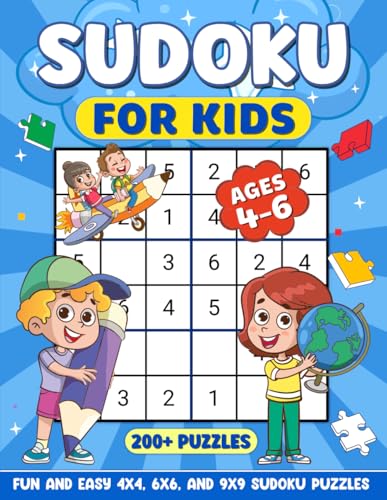
Sudoku for Kids 4-6
216 sudoku puzzles, 72 each of 4×4, 6×6 and 9×9, starting on 4×4 grids that use only the numbers 1 to 4, on large 8.5×11 pages with solutions at the back.
Learn more →Does it need pencil marks?
No, and it is better without them.
Pencil marks — writing small candidate numbers into empty cells — are a 9x9 technique, and on a grid that size they are close to essential at harder levels. On a 4x4 they are slower than simply looking. Introducing them early also robs the child of the thing 4x4 is best at teaching: holding a small amount of information in your head and acting on it.
If a child wants to write candidates on a 4x4, that is usually a signal they are ready for a bigger grid rather than a sign they need the technique.
What comes after 4x4 Sudoku?
6x6, where the boxes become rectangles, and then the full 9x9 grid.
4x4 is the entry point, not a warm-up act. A child who can solve one reliably has learned the actual rule of Sudoku and the habit of checking three regions before writing — and both transfer completely.
What comes next is 6x6, where the boxes stop being square, and that transition has its own quiet difficulty worth knowing about in advance: 4x4 vs 6x6 Sudoku for kids covers it. If you are earlier than that and wondering whether your child is old enough at all, what age can kids start sudoku answers that question, and how to teach sudoku to kids covers running the first few sessions. For how the levels work once grids reach 9x9, see Sudoku difficulty levels explained.
Among our books, Sudoku for Kids 4-6 spends the most time on 4x4 grids and is the right starting point if this stage has not happened yet. Sudoku Puzzle Book for Kids includes 120 4x4 puzzles inside a wider mix, and Sudoku for Kids Ages 6-8 starts at 4x4 and climbs through six levels. All ten are compared side by side on the sudoku books page, and more free activities are on the printables page.
Frequently asked questions
How many numbers are in a 4x4 Sudoku?
Sixteen cells, using each of the numbers 1 to 4 four times. A puzzle starts with some of them filled in; the worked example here starts with seven.
Can a 4x4 Sudoku have more than one solution?
It can. Standard puzzles are generally designed to have exactly one, and the four puzzles on this page were each checked by computer to have one. If a finished grid obeys every rule but differs from an answer key, it is still a correct solution.
Can you use letters, colours or pictures instead of numbers?
Yes. The numbers are only labels, so any four different symbols work the same way. Pictures are useful for children who do not know their numbers yet.
What age is 4x4 Sudoku for?
Many children can finish one at four or five, with an adult beside them for the first few. Grid size matters more than age; see what age can kids start Sudoku. For a way to fit Sudoku into a school break alongside other paper activities, see ideas for a screen-free winter break.
Key takeaways
Save the second question for when the first runs dry. On a 9x9 it becomes the main event soon enough.
- A 4x4 Sudoku has 16 cells: four rows, four columns and four 2x2 boxes, each holding 1 to 4 exactly once.
- Most of the grid falls to one question: which number is missing from a line that already has three?
- When no line has three, switch questions: pick a number and find the only cell in a row, column or box where it can go.
- Pencil marks are unnecessary at this size, and guessing is a habit worth never starting.
- A child who has made "check the row, the column and the box" automatic on 4x4 will pick up 9x9 far faster.