Sudoku difficulty levels run easy, medium, hard, then expert or "evil", and each step up is set by the hardest solving technique a puzzle forces you to use, not by how many numbers it starts with. Easy puzzles need only singles, where a cell or a number has just one possible place. Medium needs pencilled candidates and simple patterns such as naked pairs. Hard needs subtler ones, such as hidden pairs or X-wings. Expert and evil puzzles need long chains of logic.
Almost everyone assumes a Sudoku is hard because a lot of numbers are missing. It is an intuitive theory and it is wrong. You can build a puzzle with 29 given numbers that needs an advanced technique, and another with only 24 that never needs more than the basics. There is one of each further down this page.
What actually sets the difficulty is which technique the puzzle forces you to use before it will give up another number. That is the whole of it, and once you can see it, the labels on the front of a puzzle book start to mean something.
Does the number of clues decide Sudoku difficulty?
A Sudoku with more starting numbers is usually easier, but only on average and only loosely. The arrangement matters far more than the count. Thirty clues bunched into three boxes leave the rest of the grid barely constrained; twenty-two clues spread thoughtfully can cascade the moment you find the first one.
This is why two puzzles that look identical in density can feel like different games. It also means you cannot judge a book by flipping to a page and counting. There is no standard number of starting clues for each level: publishers that grade by count set their own thresholds, and ours are listed further down.
What techniques does each difficulty level need?
Difficulty grades are really a description of how far up this ladder a puzzle makes you climb: easy, then medium, hard, and expert or evil at the top.
Easy: scanning for singles. You look along a row, a column or a box and find a cell where only one number can possibly go. Or you find a number that has only one legal home left in its box. This is the entire toolkit for an easy puzzle, and it needs no notation — you can do it in your head, in a waiting room, without writing anything in the margins.
Medium: candidate marking, pairs and locked candidates. At some point scanning stops producing anything. Now you start pencilling the possibilities into each empty cell, and you look for structure among them: two cells in a box that can only hold the same two numbers, so no other cell in that box can hold either of them. Or a number confined to one row within a box, which means it can be eliminated from the rest of that row. This is medium territory. It is slower, it needs a pencil, and it is where most solvers spend their time.
Hard: hidden subsets and patterns across the grid. Hard puzzles reach a state where neither scanning nor simple pairs will yield anything. Progress needs a subtler relationship: two numbers that can only go in the same two cells of a box (a hidden pair, which is much harder to spot than a naked one), three cells sharing three candidates, or a pattern linking two rows that are nowhere near each other, called an X-wing. These are learnable, and none of them are guessing, but they take real concentration and a fully marked grid.
Expert and evil: longer patterns and chains. Above hard, the patterns get longer and rarer: a swordfish (an X-wing stretched across three rows), an XY-wing, or a chain of "if this cell is 4, then that one must be 7" links followed until one branch contradicts itself. Each step is still logic, but it can take many minutes of studying a fully marked grid to find, and a puzzle may need several. This is the territory books and apps label expert, extreme, diabolical or evil, although, as the sections below explain, those words are used loosely. Evil Sudoku vs hard and expert compares them and works through an XY-wing.
One example of each level
The three puzzles below were made for this article and checked by computer. Each has exactly one solution. Each was then solved by a program that always uses the easiest technique that makes progress, and the level is simply the hardest technique it was forced to use. There is no expert example: above hard, the labels vary too much between publishers for one grid to stand for them.
| Level | What it needs, at minimum | Example below | Starting numbers |
|---|---|---|---|
| Easy | Only singles: a cell with one possible number, or a number with one possible cell | Easy example | 24 |
| Medium | At least one locked candidate or naked pair | Medium example | 28 |
| Hard | At least one hidden pair, naked triple or X-wing | Hard example | 29 |
Look at the last column. The easy example has the fewest starting numbers and the hard one the most. That is the clue-count point above, made concrete: the easy grid has only 24 givens, but every one of them sits where it keeps producing singles, while the hard grid's 29 leave a knot that only a hidden pair untangles.
The answers print on a separate page.
Easy. Every step is a single. You can solve it without writing a single candidate, although with only 24 givens it takes a while to get going.
Medium. Singles take you a long way, then stop. Mark candidates in the stalled boxes and look for a number confined to one row or column inside a box: that locked candidate is what reopens the grid.
Hard. Singles and locked candidates get you part of the way. The step that breaks it is a hidden pair: two numbers that, within one unit, can only go in the same two cells, so every other candidate in those two cells can be crossed out.
Solutions
If these feel like a big jump from where you are, go back a size: how to solve a 4x4 sudoku walks through a complete small grid step by step, and the two questions it teaches are the same two singles used here.
Evil Sudoku vs Hard and Expert: What's the Difference?
"Evil" is generally the name a publisher gives to an advanced difficulty tier, usually at or near the top of its scale. There is no universal standard for it, and no consistent line between "evil" and "expert": one site's evil is another site's hard. What the word signals is a puzzle that stalls on singles and simple pairs and asks for a more advanced technique, so read the publisher's own description before trusting the label.
The table below is a rough map. It lists techniques you may meet at each label, not techniques that label guarantees. The same puzzle can be called hard by one publisher and evil by another, and software graders disagree about which techniques to count.
| Label | Where it tends to sit | Techniques you may meet (examples, not rules) | What to expect |
|---|---|---|---|
| Hard | Upper-middle of a scale | Hidden pairs, naked triples, X-wings | A fully pencilled grid, a few stalls, then a break |
| Expert | Varies: sometimes the same as hard, sometimes the same as evil | X-wings and XY-wings, sometimes a swordfish | Longer stalls, and more candidates to keep track of |
| Evil | Top or near the top of a scale | XY-wings, swordfish, longer chains of linked deductions | Long stretches where nothing moves, and possibly several advanced steps in one grid |
Some publishers also use "evil" for puzzles that are merely long, or that ask you to try a number and follow it through. Others reserve it for puzzles meant to be solved by logic alone. Whether a given puzzle can be solved without trying numbers depends on the techniques you know, so a book's description matters more than its label.
Standard published Sudoku puzzles are generally designed to have a unique solution, but uniqueness and difficulty are separate properties. A puzzle with one solution can still need obscure techniques, and a label like "evil" or "extreme" says nothing on its own about how many solutions a grid has or how it is meant to be solved.
Worked example: an XY-wing
An XY-wing is a typical advanced technique, the kind of step expert and evil puzzles may call for. It is one example of the step up from hard, not a definition of any label, and plenty of puzzles never need it.
The grid below is an original puzzle with 28 starting numbers, checked by computer to have exactly one solution. It is shown at the point where every single has been placed. The small numbers are the candidates still possible in each empty cell. At this point a program that tries locked candidates, naked pairs and triples, hidden pairs and X-wings finds nothing to do, so the grid is genuinely stuck for every technique used earlier on this page.
Cells are named by row and column, so r3c7 is row 3, column 7. Here is how the pattern works:
- Find the pivot. r3c7 can only be 4 or 5. A cell with exactly two candidates is the start of an XY-wing.
- Find the first wing. r7c7 sees the pivot (same column) and can only be 4 or 8. It shares the 4 with the pivot and brings in a new number, 8.
- Find the second wing. r3c3 sees the pivot (same row) and can only be 5 or 8. It shares the 5 with the pivot and holds the same new number, 8. The two wings do not see each other.
- Follow both possibilities. If the pivot r3c7 is 4, then r7c7 cannot be 4 (same column), so r7c7 is 8. If the pivot is 5, then r3c3 cannot be 5 (same row), so r3c3 is 8. The pivot has no other choice, so at least one of r7c7 and r3c3 is 8.
- Remove the 8 from any cell that sees both wings. r7c3 sees r7c7 (same row) and r3c3 (same column). Whichever wing holds the 8, r7c3 cannot, so the 8 is crossed out of r7c3.
- Collect the result. r7c3 had only 2 and 8 left, so it is now 2, and the singles you already know finish the rest of the grid.
You never guessed. Each of the two branches is a fact about the grid, and the elimination is true in both. That is the difference between an advanced pattern and trial and error: you do not try a number and see whether the grid breaks, you show that a number is impossible whichever way the pivot goes.
This is one route, and a different advanced technique may also move this grid. The point of the example is how a step like this looks, and why it is a different kind of work from the singles and pairs at the easier levels.
Is there a standard for Sudoku difficulty levels?
No. This is the part that frustrates people, and it is worth saying plainly: nobody governs these words. One publisher's "hard" is another's "medium". A newspaper's Saturday puzzle might be easier than a book's mid-range one.
The practical consequence is that difficulty labels are only reliable within a single source. Once you have found a book whose "medium" matches what you want, that grading is meaningful to you — but it does not transfer to the next publisher on the shelf.
How are MindGrid Sudoku books graded?
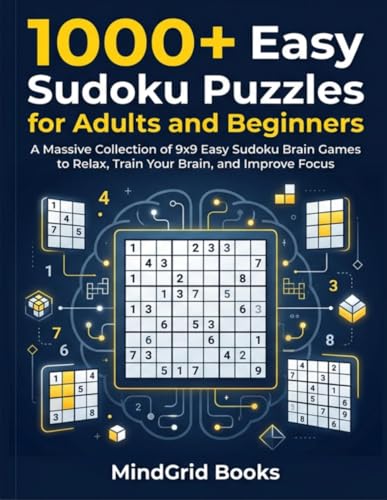
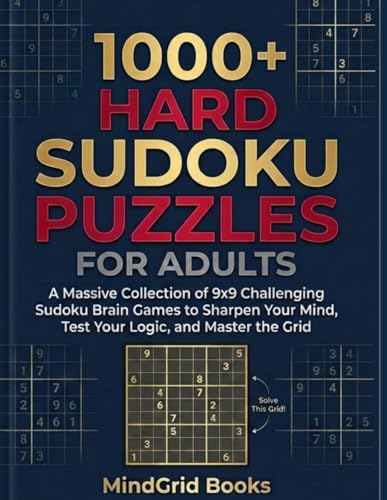
Our three single-level books use the simplest grading there is: the number of starting clues, held the same from the first page to the last. 1000+ Easy Sudoku Puzzles gives 36 numbers in every grid, 1000+ Medium Sudoku Puzzles gives 32, and 1000+ Hard Sudoku Puzzles gives 28, with 1,008 puzzles in each.
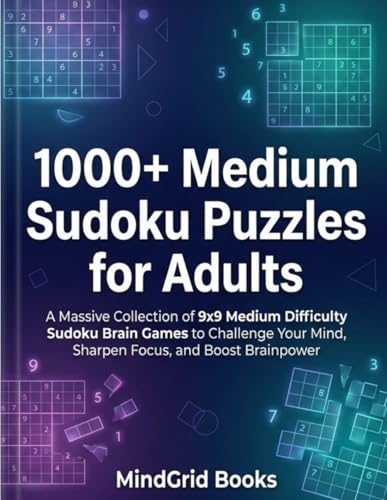 Available on Amazon
1000+ Medium Sudoku Puzzles
Take your skills to the next level with medium difficulty puzzles. Ideal for players who want a balanced challenge.
Learn more →As the examples above show, clue count is a rough guide rather than a guarantee of which techniques a grid will need, so read those labels as "fewer starting numbers" rather than as a technique promise. What a single-level book does give you is consistency: there is no warm-up section to page past and no change of level forty pages in. If you want to see the medium book's format before buying, its page has two free sample puzzles to print.
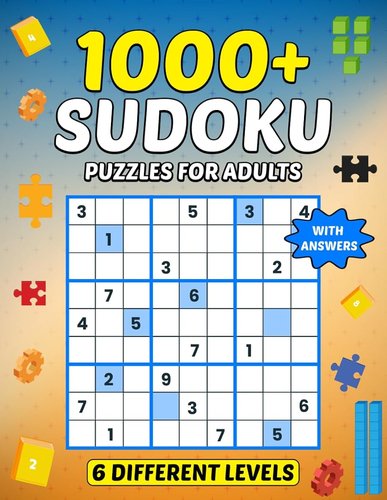
The alternative is 1000+ Sudoku Puzzles for Adults, which puts all six levels in one book at 168 puzzles each, running from very easy to extreme, with every page stating its own level. That is the better buy if you do not yet know where you sit, or if more than one person will be using it.
Which Sudoku difficulty level should you choose?
The useful test is not whether you can finish a puzzle. It is what happens when you get stuck.
If you get stuck and the answer arrives after another minute of scanning, you are in the right place. If you get stuck and the only way forward is to start pencilling in candidates and you enjoy that, move up. If you get stuck, mark the whole grid, and still cannot see it — and that feels like a chore rather than a challenge — move down. There is no prize for grinding.
Most people who describe themselves as intermediate are happiest on medium puzzles and reach for hard ones occasionally, which is exactly the right way round. Easy puzzles are not a beginner's phase to graduate from either; plenty of long-time solvers keep an easy book specifically for the evenings when they want the rhythm of it rather than the fight.
Choosing for a child is a different question, and grid size matters more than the difficulty label: what age can kids start Sudoku covers the 4x4, 6x6 and 9x9 stages.
How long does a Sudoku take at each level?
It varies a great deal from solver to solver, so treat any figure as a rough guide. Difficulty and time are related but not the same. An easy 9x9 might take four minutes and a hard one forty, but a hard puzzle is not simply an easy one stretched out — it has a different shape, with long flat stretches where nothing moves, then a break that unlocks a cascade.
If you are choosing a book for a commute or a lunch break, that shape matters as much as the label. An easy puzzle fits neatly into a fixed slot of time. A hard one does not, and being interrupted mid-grid with a page of candidate marks is its own small frustration.
Whichever level you land on, you can compare the whole range on the sudoku books page.
Frequently asked questions
How many clues does an easy Sudoku have?
There is no fixed number. Grading by clue count alone is rough: the easy example on this page has 24 clues and the hard one 29. The fewest clues any valid 9x9 Sudoku can have is 17, proved by an exhaustive computer search in 2012.
Is it cheating to use pencil marks?
No. Writing candidates into empty cells is a standard technique, and from medium level up most solvers need it. Easy puzzles can be finished without them.
How is a Sudoku's difficulty graded by computer?
A solver program applies the easiest technique that makes progress at each step and records the hardest one it was forced to use. That is how the three examples here were graded. A person may still find a particular grid harder or easier than its label.
Does every Sudoku have exactly one solution?
Standard published puzzles are generally designed to have one, and the three examples on this page were checked by computer to have exactly one. Uniqueness and difficulty are separate properties, though: how many solutions a grid has says nothing about which techniques it needs.
Key takeaways
- Difficulty is set by the hardest technique a puzzle requires, not by how many numbers it starts with.
- Easy needs only singles; medium needs candidate marking with locked candidates or naked pairs; hard needs hidden pairs, naked triples or X-wings; expert and evil need longer patterns and chains.
- Clue count is a loose guide at best: on this page the easy example has 24 clues and the hard one 29.
- "Evil" generally marks a publisher's advanced tier, but it has no standard meaning and no consistent difference from "expert"; the labels overlap.
- Nobody governs difficulty labels, so a grade is only reliable within one publisher or one book.
- The right level is the one where getting stuck feels like a challenge rather than a chore.