What's inside
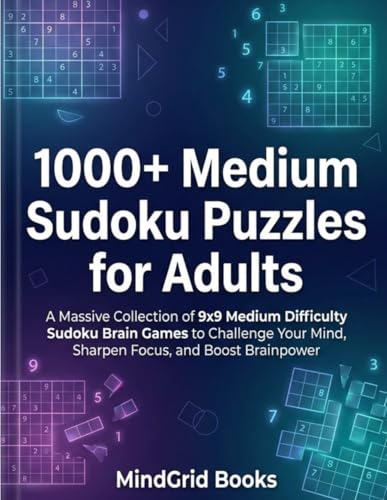
- 1,008 medium sudoku puzzles on classic 9×9 grids
- Twelve puzzles to a page, so a thousand of them fit in one manageable book
- Every puzzle starts with 32 of its 81 numbers filled in — the same level from the first page to the last
- A solution grid for every puzzle, printed at the back
- Large 8.5 × 11 pages with room to pencil in candidates
- Black and white interior on white paper, 115 pages
How “medium” is set in this book: by the number of starting clues. Each grid gives you 32 numbers, fewer than the 36 in 1000+ Easy Sudoku Puzzles and more than the 28 in 1000+ Hard Sudoku Puzzles. Clue count is only a rough guide to difficulty — our guide to Sudoku difficulty levels covers what else matters — but it is held constant here, so nothing jumps around from page to page.
What is medium sudoku?
Medium sudoku is the level where scanning stops being enough on its own. You can place a good run of numbers the way you would in an easy puzzle, by finding a square where only one number fits, and then the grid stalls. To get it moving again you pencil the possible numbers — the candidates — into the empty squares and look for simple patterns among them.
Nobody governs the word. One publisher’s medium is another’s easy, so a label only means something within one source. On this site, a medium puzzle is one that needs at least one naked pair or locked candidate and nothing harder, which is how the two free samples below were graded.
Easy vs medium vs hard
Easy
Solved by scanning alone: every step is a square with one possible number, or a number with one possible square. No pencil marks needed.
Medium
Scanning gets you started, then stalls. You mark candidates and use a naked pair or a locked candidate to reopen the grid. Slower, and done with a pencil.
Hard
Pairs and locked candidates run out too. Progress needs hidden pairs, triples or an X-wing, worked across a fully marked grid.
Techniques for medium puzzles
- Scan number by number. Take the 1s, then the 2s, and for each box ask where that number can still go. This finds most of the early placements.
- Then square by square. Where a row, column or box is nearly full, check which number each empty square is missing.
- Pencil in candidates when you stall. Write the possible numbers small in each empty square of the stuck area. Medium puzzles rarely give way without this.
- Look for naked pairs. If two squares in the same row, column or box can each hold only the same two numbers, those two numbers belong to those two squares. Cross them off everywhere else in that row, column or box.
- Use locked candidates. If, inside one box, a number can only go in a single row, it must sit in that row within the box — so cross it off the rest of that row outside the box. The same works for columns.
- Re-scan after every elimination. Crossing off one candidate often leaves a square with a single option. A medium solve usually alternates: one pattern, then a burst of easy placements.
If none of that moves the grid, the puzzle probably needs a harder technique than medium, such as a hidden pair.
Try two free medium puzzles
These two medium puzzles were made for this page — they are original samples, not pages from the book. Each one was checked by computer to have exactly one solution, and each needs at least one step beyond simple scanning (a locked candidate or a naked pair), which is how this site defines medium. Print them, and the solutions come out on a separate page.
The answers print on a separate page.
Get 1000+ Medium Sudoku Puzzles on Amazon
Solutions
Who this book is for
Solvers who have outgrown easy
You already know the rules and the basic scan along rows, columns and boxes, and you want grids with fewer numbers to start from.
Regular players
One level throughout and a lot of puzzles, so a daily habit does not run out in a month.
Not a first sudoku book
If you have never solved one, start with the easy book or the six-level collection. Children learning the rules will do better with 4×4 grids first.
Good to know
- Trim size 8.5 × 11 inches — the large format, not a pocket book
- Puzzles run first, then the solutions section, numbered to match
- One difficulty only, on purpose: no hunting for the section that suits you
- Available in paperback and on Kindle
- Want medium puzzles on the move? The travel sudoku book has a 50-puzzle medium section in a 5 × 8 format
Questions about medium sudoku
Is medium sudoku hard?
It is a clear step up from easy, mostly because it asks for a method rather than just a sharp eye. Once you pencil in candidates and can spot a naked pair, medium puzzles become steady work. If they still feel out of reach, spend a little longer on easy puzzles first: the scanning habit is what medium builds on.
How long does a medium sudoku take?
There is no single answer. It depends on the puzzle, on how you mark candidates and on how much you have practised, and because difficulty labels differ between publishers, times do not compare well from one source to another. Expect a medium grid to take noticeably longer than an easy one at first, mostly because of the candidate marking, and to speed up as you start spotting pairs without writing everything out. To measure your progress, time yourself on puzzles from the same book.
How many numbers does a medium sudoku start with?
There is no fixed number, and the count is only a loose guide to difficulty. The two free samples on this page start with 28 numbers each, every grid in the book starts with 32, and the difficulty guide shows an easy puzzle that starts with fewer numbers than a hard one.
What should I try after medium sudoku?
1000+ Hard Sudoku Puzzles gives 28 numbers in every grid. If you would rather step up gradually, 1000+ Sudoku Puzzles for Adults climbs through six levels, from very easy to extreme.
Ready for the level that fights back a little? Get your copy on Amazon.