A logic or detective puzzle book gives you a mystery and every fact needed to solve it, and nothing else: no luck, no trivia, no guessing. MindGrid Books publishes two. In The Detective's Logic Casebook you read numbered clues and fill in a logic grid until one suspect is left. In Detective Mystery Word Search you search a letter grid, and the words you find are the evidence.
Two ways to solve a mystery
Both books are paperback collections of original cases with a full solution for each. What differs is the puzzle you work through to reach the answer.
| The Detective's Logic Casebook | Detective Mystery Word Search | |
|---|---|---|
| How you solve it | Read the numbered clues and mark a logic grid, ruling suspects out until one remains | Find the hidden words; which words are there, where they lie and which way they run is the evidence |
| Cases | 40 | 50 |
| Levels | Four: beginner, intermediate, advanced and master | Three: beginner, intermediate and advanced |
| Help along the way | Three hints per case, then a step-by-step solution | A step-by-step solution with the marked grid |
| Paperback | 7 × 10 inches, 265 pages | 6 × 9 inches, 170 pages |
| Free pack | 3 mysteries with printable worksheets | 5 investigations, one for each method |
The two books
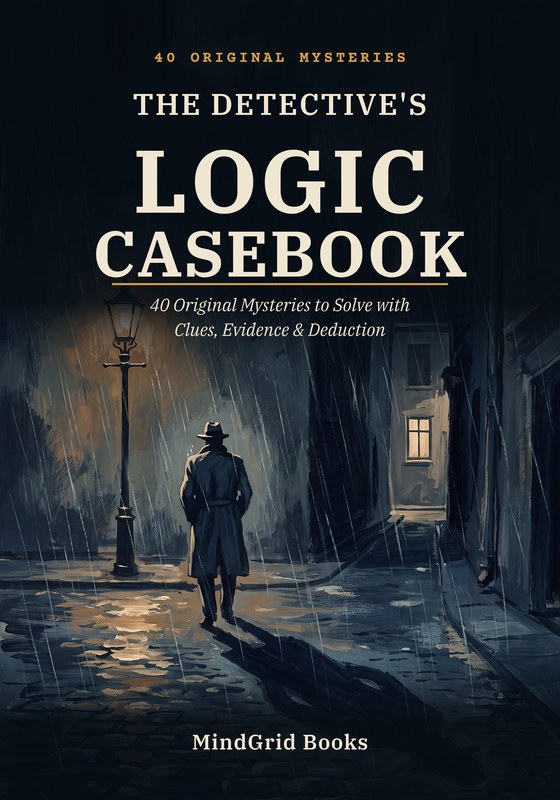
The Detective's Logic Casebook
40 original mysteries, each with a suspect list, numbered evidence and a ready-made logic grid. Harder cases add arrival times, floor plans and witness statements, and a solver program checked every case for exactly one answer.
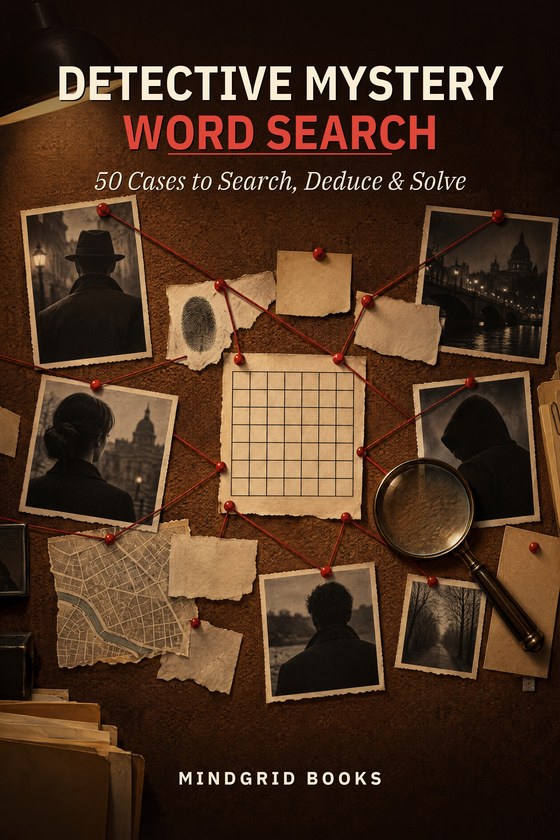
Detective Mystery Word Search
50 mysteries hidden in word-search grids. Each case uses one of five methods: forensic traces, alibi photos, a floor plan, leftover letters that expose a false statement, or a route traced across a map.
Which one to start with
You enjoy logic grids
Choose The Detective's Logic Casebook. Every case is a logic grid puzzle with a story around it, and the master level runs to five suspects and up to 17 clues.
You enjoy word searches
Choose Detective Mystery Word Search. The searching is familiar; the twist is that you then read the finished grid as evidence to name the culprit.
You are new to both
Either works as a first detective book. Both open with short beginner cases of three or four suspects, and every case explains its answer step by step.
Try a case before you buy
Each book has its own free printable pack, written for the pack and not taken from the book. You get the download on the book's page after signing up:
- 3 free detective mysteries: a beginner, an intermediate and an advanced case, with printable worksheets, three layers of hints and full solutions.
- 5 free word-search investigations: one case for each of the five methods, with the marked grids and every step of the reasoning at the back.
New to grid deduction? Our guide on how to solve a logic grid puzzle, step by step walks through one complete puzzle and the strategies the harder cases need.
In short: pick the casebook if you like reasoning from written clues, and the word search if you like hunting for words and turning what you find into evidence. The two do not overlap, so finishing one gives nothing away in the other. Both are paperbacks on Amazon, or browse the full MindGrid catalogue.