There is no good evidence that Sudoku raises a child's IQ or improves their memory in general: brain-training gains rarely carry over beyond the task being practised, and the best-known Sudoku study was in adults over fifty. What Sudoku does offer children comes from its structure. It rewards deduction over guessing, it marks its own work, it has a clear end, and it runs on paper.
Search for the benefits of Sudoku for children and you will be told it boosts IQ, improves memory, sharpens concentration and wards off cognitive decline. We publish Sudoku books for children, so it would suit us to repeat all of that.
We are not going to, because it does not hold up. The honest case for Sudoku is narrower, better evidenced in a different way, and — we think — more useful to a parent deciding whether to bother.
Does Sudoku make kids smarter?
Not as far as the evidence shows. The research people cite is about adults, and it does not show that puzzles improve general thinking.
Two things are worth separating: whether puzzles improve general thinking, and whether anyone has studied this in children.
On the first, the evidence is discouraging. The largest test of brain training was run with the BBC and published in Nature in 2010: 11,430 participants trained online for six weeks. They got better at the tasks they practised. Those gains did not transfer to untrained tasks. A comprehensive review in Psychological Science in the Public Interest in 2016 reached the same conclusion — brain-training programmes show little effect outside the narrow range of what is repeatedly practised.
The study most often waved at Sudoku specifically comes from the PROTECT research at the University of Exeter, which found that among roughly 19,000 adults aged 50 and over, those who did number puzzles more often scored better on attention, reasoning and memory tests.
That finding is real, but it is cross-sectional and self-reported — a snapshot, not a trial. The researchers did not claim causation, and the independent experts asked to comment on it were blunt about why. Professor Braddick: "This could just as well result from those with 'sharper brains' being more likely to want to do puzzles, as the puzzles having any causative role." Professor Howard made the same point about education and ability predicting who enjoys puzzles in the first place.
And on the second question: that work is all in adults over fifty. We are not aware of a body of controlled research testing Sudoku in school-age children at all. So the popular claim — Sudoku makes kids smarter — is unsupported twice over: the transfer effect is doubtful in adults, and the population is wrong.
| Common claim | What the evidence cited here shows |
|---|---|
| Sudoku raises IQ | We know of no controlled research in children. In the largest brain-training trial (Nature, 2010), gains did not transfer to untrained tasks |
| Sudoku improves memory and reasoning | Adults aged 50+ who did number puzzles more often scored better (PROTECT), but the study was a snapshot and cannot show the puzzles caused it |
| Sudoku wards off cognitive decline | Not shown by these studies; the adult research is correlational |
| Sudoku teaches patience and checking | Not a research finding — a property of the puzzle you can see at home: a wrong guess leads to a contradiction, and the grid shows when it is wrong |
What are the real benefits of Sudoku for kids?
They are properties of the puzzle rather than proven outcomes: it rewards deduction over guessing, it marks its own work, being stuck is part of it, it finishes, and it needs no screen.
Drop the cognitive claims and something more modest is left, which is not a claim about outcomes at all. It is a description of what the activity structurally requires. These are properties of the puzzle, and you can verify every one at your own kitchen table.
Sudoku rewards deduction over guessing. A wrong guess usually produces a contradiction a few moves later and the child has to unpick it. Very few children's activities have that property. Most reward a fast plausible answer; this one punishes it, quietly and without an adult having to say anything.
It marks its own work. The grid tells you that you were wrong — not a parent, not a teacher, not a red pen. That is unusual and it changes the emotional shape of being wrong. A mistake becomes information about four moves ago rather than a verdict.
Being stuck is the activity, not a failure of it. The pause before a child sees the next move is the whole thing. A child who learns to sit in that pause for thirty seconds instead of asking for help has practised something genuinely useful, and it is the closest thing to a transferable benefit on this list.
It finishes. A completed grid is unambiguously done. Children get less of this than adults assume, and it is a large part of why they will do a second one.
It runs on paper. No screen, no scoring, no next level, no notification. The only reward is the finished grid, which is worth something precisely because nothing has been engineered to make it moreish.
None of that is a promise about test scores. It is a description of an activity worth twenty minutes, which is a lower bar and a much more honest one.
 Available on Amazon
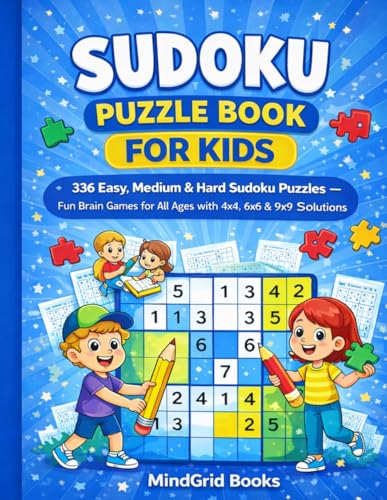
Sudoku Puzzle Book for Kids
336 puzzles across three grid sizes: 120 4×4, 108 6×6 and 108 9×9, each size running from easy to hard, with a full answer key at the back.
Learn more →Why we are careful about this
Unsupported claims in children's-book marketing are common and they cost something real. A parent who buys a puzzle book expecting measurable academic gains has been sold a disappointment, and when it does not arrive the reasonable conclusion is that puzzles were a waste of time.
They were not. They were just never going to do that job.
We would rather sell a book to somebody who wanted the thing it actually is: a quiet, self-marking, screen-free activity that most children enjoy and that rewards patience over speed.
How do you get the most out of Sudoku with a child?
Keep it a patience activity. If those are the benefits, a few things follow about how to use the books.
- Do not time them. Speed converts a patience activity into a test, and it rewards guessing — the one habit the puzzle is otherwise good at removing.
- Start below their level. A child who finishes concludes they are good at puzzles. A child who stalls concludes the opposite, and stops. What age can kids start sudoku covers where to start, and it is usually earlier than parents expect.
- Do not give answers. The stuck pause is the value. How to teach sudoku to kids sets out a hint ladder that gets a child moving without handing over a number.
- Stop while they still want more. Enthusiasm is the resource that runs out, not ability.
Where should a child start with Sudoku?
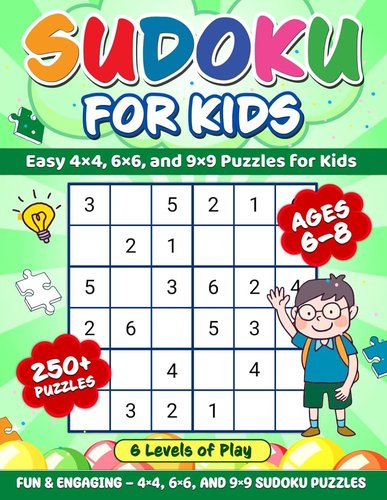
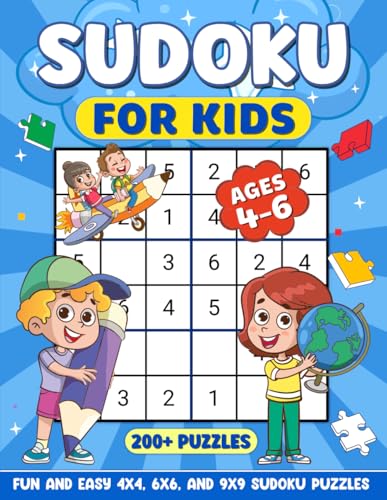
Grid size matters more than the age on the cover. Sudoku for Kids 4-6 stays on 4x4 grids long enough for the habit to form — how to solve a 4x4 sudoku explains the method. Sudoku for Kids Ages 6-8 climbs from 4x4 to 9x9 across six levels, Sudoku Puzzle Book for Kids mixes all three sizes, and Sudoku for Kids Ages 8-12 is weighted to full 9x9. The step between the small grids is covered in 4x4 vs 6x6 sudoku for kids, and all ten titles are compared on the sudoku books page.
Frequently asked questions
Is Sudoku a maths activity?
No. The digits are symbols, and no adding or counting is involved; the puzzle works just as well with letters, colours or pictures. It is a logic puzzle, not arithmetic practice.
Does Sudoku improve school results?
No study we know of has shown that it does in children. It gives practice at checking work and staying with a problem, which are useful habits, but that is a description of the activity rather than a measured effect.
Is paper Sudoku better than a brain-training app?
Neither has good evidence of making children smarter. The practical difference is that a paper puzzle has no scores, streaks or notifications, and it needs no device.
How much Sudoku should a child do?
There is no evidence-based amount. As a practical guide, a short session that ends while the child still wants more keeps them coming back; twenty minutes is a comfortable upper end.
Key takeaways
Sudoku will not make your child smarter, and anyone telling you otherwise is citing correlational research about adults aged 50 and over. What it will do is give them a thing that cannot be rushed, marks itself, and ends.
- We are not aware of controlled research showing that Sudoku raises children's IQ or school results.
- In the largest brain-training trial (11,430 participants, Nature, 2010), practice improved the trained tasks but did not transfer to untrained ones.
- The study most often quoted for Sudoku (PROTECT, adults aged 50 and over) is correlational: it cannot show that puzzles caused the better scores.
- The dependable benefits are structural: the puzzle rewards deduction over guessing, the grid marks its own work, and every puzzle has a clear end.
- Use it as a patience activity: no timer, no handing over answers, and a grid size the child can finish.