These ten puzzles are for a child who already knows how every piece moves and is ready for the next thing: spotting a move that wins. Nine of them are solved in a single move. The last one takes two.
They are not graded by age. What matters is what the child can already do: if they can set up the board and play a legal game without help, they can start at puzzle 1. If moving the pieces is still new, play a few games first and come back.
How to read a puzzle
- Look at who is to move first. Every diagram says White to move or Black to move above the board. Two of these puzzles are Black's turn, so do not skip the label.
- White pieces are drawn as outlines, black pieces are solid. White always plays up the board, from row 1 towards row 8.
- Squares have names. Columns are the letters a to h, rows are the numbers 1 to 8, so the bottom-left corner is a1. Under each board there is a list of every piece and its square, in case a printed piece is hard to make out.
- Answers use short notation. K is king, Q queen, R rook, B bishop, N knight, and a pawn has no letter. "x" means a capture, "+" means check and "#" means checkmate. So Rxd7 is "rook takes on d7" and Ra8# is "rook to a8, checkmate".
What the puzzles practise
- Mate in one (puzzles 1–3): a move that gives check and leaves the king no escape square, no piece to block with and no way to capture the attacker.
- Forks (puzzles 4–5): one piece attacks two enemy pieces at once, so only one of them can be saved.
- Pins (puzzles 6–7): a piece cannot move away because the king would be left in check behind it.
- Hanging pieces (puzzles 8–9): a piece that nothing protects can be taken for free. Counting the guards before capturing is the habit that matters most.
- Mate in two (puzzle 10): one quiet move that leaves every defence losing.
The answers print on a separate page.
The puzzles
Puzzle 1: Checkmate on the back row
Mate in one
White to move
Black: king g8, knight c3, pawn f7, pawn g7, pawn h7.
White can checkmate in one move. Find it.
Your answer:
Puzzle 2: Queen and king together
Mate in one
White to move
Black: king h8.
White can checkmate in one move. Find it.
Your answer:
Puzzle 3: Black strikes first
Mate in one
Black to move
Black: king g8, queen g5, bishop b7, pawn f7, pawn g7, pawn h7.
This time it is Black's turn. Black can checkmate in one move.
Your answer:
Puzzle 4: The knight's double attack
Fork
White to move
Black: king e8, rook a8, pawn d7, pawn f7, pawn g7, pawn h7.
White to move. Find the move that attacks two black pieces at once.
Your answer:
Puzzle 5: Even a pawn can fork
Fork
White to move
Black: king g8, bishop d6, knight f6, pawn f7, pawn g7, pawn h7.
White to move. One small pawn move attacks two black pieces.
Your answer:
Puzzle 6: Stuck in front of the king
Pin
White to move
Black: king e8, queen e5.
White to move. Find the rook move that wins the black queen.
Your answer:
Puzzle 7: The bishop's pin
Pin
White to move
Black: king e8, queen d7, pawn f7, pawn g7, pawn h7.
White to move. Pin the black queen so she cannot escape.
Your answer:
Puzzle 8: Count the guards
Hanging piece
White to move
Black: king g8, bishop d7, knight c6, pawn b7, pawn f7, pawn g7, pawn h6.
White to move. One black piece is completely unguarded. Take it.
Your answer:
Puzzle 9: A free knight for Black
Hanging piece
Black to move
Black: king g8, bishop b7, pawn f7, pawn g7, pawn h6.
Black to move. White has left a piece unguarded.
Your answer:
Puzzle 10: Two rooks climb the ladder
Mate in two
White to move
Black: king h8, pawn a7.
The challenge puzzle. White can force checkmate in two moves. What is the first move?
Your answer:
Answers and explanations
Try each puzzle before reading its answer. If a child finds a different move, set up the position on a real board and play it out: every answer below was checked by computer against all of the other side's legal replies, so the explanation will show where the alternative falls short.
Puzzle 1 (mate in one): Ra8# — Rook to a8, checkmate.
The rook slides up to a8 and checks the king along the top row. Black's own pawns on f7, g7 and h7 block every escape square, nothing can capture the rook, and the knight on c3 cannot reach the top row to block. This pattern is called a back-rank mate.
Puzzle 2 (mate in one): Qb8# — Queen to b8, checkmate.
The queen checks along the top row and also covers g8. The white king guards g7 and h7, so the black king has no square to go to. Watch out for Qh1+: it is check, but the king simply steps to g8.
Puzzle 3 (mate in one): Qxg2# — Queen takes the pawn on g2, checkmate.
The queen captures on g2 with check. The white king cannot take her, because the bishop on b7 protects g2 all the way along the long diagonal. The queen also covers g1, and h2 is blocked by White's own pawn. The rook on f1 cannot help: rooks move in straight lines, and g2 is diagonal from f1.
Puzzle 4 (fork): Nc7+ — Knight to c7, check. Main line: Nc7+ Kd8 Nxa8.
From c7 the knight attacks the king on e8 and the rook on a8 at the same moment. Black has to get out of check first, so on the next move the knight takes the rook. Attacking two pieces with one move is called a fork, and knights are especially good at it because their jump is hard to see coming.
Puzzle 5 (fork): e5 — Pawn to e5. Main line: e5 Bxe5 dxe5.
The pawn on e5 attacks the bishop on d6 and the knight on f6 at the same time, and the d4 pawn protects it. Black cannot save both pieces. If the bishop takes the pawn, the d-pawn takes back and White has won a bishop for a pawn. If either piece moves away, the pawn takes the other one.
Puzzle 6 (pin): Re1 — Rook to e1. Main line: Re1 Qxe1+ Kxe1.
The rook moves onto the e-file, lining up with the queen and the black king behind her. The queen cannot step off the e-file, because that would leave her own king in check: she is pinned. Her best try is to take the rook, but the white king on f2 takes her back. White gives up a rook (5 points) and wins a queen (9 points).
Puzzle 7 (pin): Bb5 — Bishop to b5. Main line: Bb5 Qxb5 Nxb5.
The bishop on b5 attacks the queen on d7, and the black king is right behind her on the same diagonal, so the queen may not move away. If she takes the bishop, the knight on c3 takes her. White trades a bishop (3 points) for a queen (9 points).
Puzzle 8 (hanging piece): Rxd7 — Rook takes the bishop on d7.
Before you capture, count who guards each piece. The knight on c6 is guarded by the pawn on b7 and by the bishop, so Bxc6 is only a fair trade. The bishop on d7 is guarded by nothing at all, so the rook takes it for free. A piece nobody protects is called a hanging piece.
Puzzle 9 (hanging piece): Bxe4 — Bishop takes the knight on e4.
The knight on e4 sits on the bishop's long diagonal and no white piece protects it, so Black simply takes it. Notice the pawn on h6: it gives the black king an escape square, so after the capture White's rook check on d8 is not checkmate. The king just steps to h7.
Puzzle 10 (mate in two): Rxa7 — Rook takes the pawn on a7, then rook to b8 is checkmate. Main line: Rxa7 Kg8 Rb8#.
After Rxa7 the rook guards the whole seventh row, so the black king is trapped on the top row. Kg8 is Black's only legal move, and then Rb8 is checkmate. Because Black had only one reply and it runs into mate, the mate is forced. The two rooks work like the rungs of a ladder, one row each.
Where to go next
A child who solved most of these is ready for a steady supply of the same kind of puzzle. Doing a few a day works better than a long session once a week, because the point is to make the patterns familiar enough to spot in a real game.
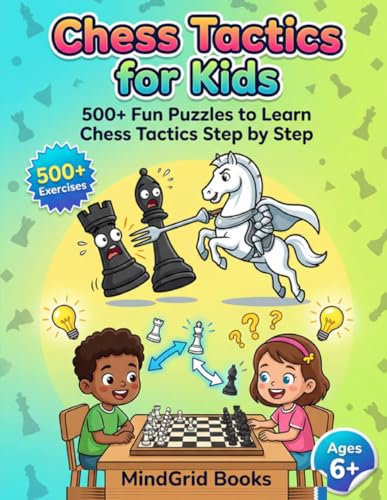
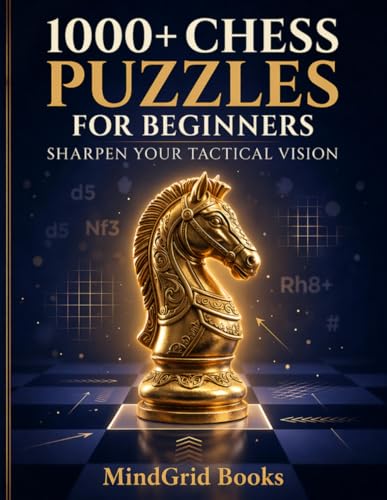
Our Chess Tactics for Kids is built for exactly that stage: 504 puzzles taken from real games, six large diagrams to a page, three sections that get harder as the child improves, and full solutions at the back. It assumes the child knows how the pieces move, as this page does. For an older beginner or an adult, 1000+ Chess Puzzles for Beginners covers the same tactics with twelve smaller diagrams to a page.
If you like puzzles with a clear answer key, there are more on the free printables page, including Sudoku for beginners and a geography quiz.