A chess tactic is a short sequence of forcing moves that wins material or checkmates the opponent. Beginners get the most from five patterns: the fork, the pin, the skewer, the discovered attack and mate in one. Learn to recognise each shape, then build a habit of checking every check, capture and threat before you move.
Many beginner games are decided by one piece left hanging or one tactic nobody saw, not by a long plan. That is why tactics reward the time you give them early on. This guide goes through each pattern in the order it is usually easiest to learn, then covers how to calculate, how to practise, and what to do next. It assumes you already know how every piece moves.
What are chess tactics?
A tactic is a concrete, short-term idea: a move or a short run of moves that gains something now. Strategy is the longer-term planning around it, such as where to put your pieces and which pawns to keep. The two work together, but they are different skills, and tactics are the one you can train with a single position and a clear answer.
Most tactics have three parts:
- A target: a piece that is undefended, badly defended, or tied to something more valuable, or a king with few escape squares.
- A forcing move: a check, a capture or a threat that limits what the opponent can sensibly reply.
- A payoff: material won, or checkmate.
Everything below is a variation on that idea.
Why should beginners learn tactical patterns first?
Because beginner games are usually lost to something small and concrete. A knight is attacked twice and defended once. A queen steps onto a square where a pawn can take it. A rook leaves the back row and the king has nowhere to go. You do not need a deep opening or an endgame textbook to stop that happening; you need to notice the pattern when it appears on the board.
Patterns also make calculation easier. Once you know what a fork looks like, you stop searching the whole board and start asking a smaller question: is there a piece of mine, or theirs, that could attack two things at once? Part of what separates stronger players is that they recognise the shapes sooner, so they only need to calculate the moves that matter.
What is a fork?
A fork is one move that attacks two or more enemy pieces at the same time. The opponent can only deal with one threat, so you win the other.
Any piece can fork, but two are especially common:
- Knights. A knight's L-shaped jump is awkward to see coming, and because a knight jumps over other pieces, the attacked pieces cannot block it. A knight landing on a square that attacks the king and the queen is called a royal fork.
- Pawns. A pawn that steps forward so it attacks two pieces diagonally wins material at the cost of almost nothing.
Before you play a fork, check two things. Is the forking piece safe on its new square? And does the opponent have a check or a capture that breaks the fork before you collect? If you want to see forks drawn out on a diagram, work through ten free chess puzzles for kids, with answers; two of them are forks, and the explanations walk through why the fork works.
What is a pin?
A pin is an attack on a piece that cannot move away without exposing something more valuable behind it. Only bishops, rooks and queens can pin, because the pinning piece has to attack along a line.
There are two kinds:
- An absolute pin is a pin against the king. The pinned piece cannot legally move off the line at all, because that would leave its own king in check.
- A relative pin is a pin against another valuable piece, such as a queen. The pinned piece is allowed to move, but doing so loses the piece behind it.
A pinned piece is also a poor defender, because it is not free to capture wherever it is needed. That is how a pin often turns into a win: you attack the pinned piece again, and it cannot run.
What is a skewer?
A skewer is a pin turned round. You attack a valuable piece and, when it moves out of the way, you capture the piece that was standing behind it. A bishop, rook or queen is again the attacking piece.
The easy way to keep them apart is to ask which piece is in front:
| Pattern | Piece in front | Piece behind | What happens |
|---|---|---|---|
| Pin | The less valuable piece | The more valuable piece | The front piece is stuck, or moving it loses the one behind |
| Skewer | The more valuable piece | The less valuable piece | The front piece must move, and the one behind is captured |
A king skewered along a line is the cleanest example: it is in check, it has to step aside, and whatever was sitting behind it on that line is now attacked.
What is a discovered attack?
A discovered attack happens when you move one piece and, by doing so, uncover an attack from a different piece behind it. You then have two things happening at once: the piece that moved can do something of its own, and the piece that was uncovered is now attacking.
It becomes very strong when the uncovered attack is a check. In a discovered check, the piece that moved is free to capture something or make a threat, and the opponent has to answer the check first. In a double check, both the moved piece and the uncovered piece give check at once, and the only legal reply is to move the king.
When you look for one, scan for your own long-range piece (a bishop, rook or queen) with one of your own pieces standing in its way, aimed at something that matters.
What is a double attack?
A double attack is any single move that creates two threats at once. A fork is the best-known example, but the idea is broader:
- A queen move that attacks an undefended piece and threatens checkmate.
- A rook that attacks two loose pieces along a row.
- A discovered attack where both the moved piece and the uncovered piece make a threat.
The practical lesson is the same each time. A defender can usually answer one threat per move, so two threats at once win something. Each of these five patterns has worked examples, with diagrams, in forks, pins and skewers for beginners.
What is mate in one?
Mate in one is a single move that gives checkmate. For a move to be checkmate, three things must all be true: the king is in check, it has no square to move to, and the check cannot be blocked or captured.
That checklist is also how you find it; the step-by-step method, with diagrams, is in mate-in-one chess puzzles for beginners. To search for it, look at the enemy king and ask:
- Which squares can it move to? Are any of them covered, or blocked by its own pieces?
- Which of my pieces can give check this move?
- After the check, can the opponent capture the checking piece, or put something in the way?
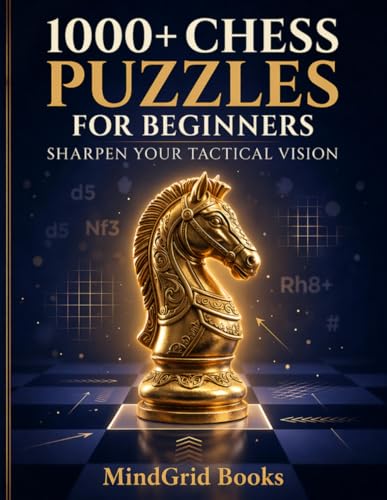
If every answer closes the door, that is the move. Beginners who want a lot of repetition at this should work through the one-move puzzles in 1000+ Chess Puzzles for Beginners, which includes 144 mate-in-one positions taken from real games.
What are the basic checkmate patterns?
Most beginner checkmates are one of a handful of shapes. Learn these and a lot of mates stop looking like puzzles.
- Back-rank mate. The king is on its back row, hemmed in by its own pawns, and a rook or queen gives check along that row. It is common because players push the pawns in front of their king and forget it has no way out.
- Smothered mate. A knight checkmates a king that is surrounded by its own pieces. The classic version has a king in the corner, boxed in by its own rook and pawns, and a knight giving the final check.
- Queen and king mate. The queen gives check from a square protected by the king or another piece, so the king cannot simply capture it.
- The ladder (or roller) mate. Two rooks, or a rook and a queen, take turns checking along adjacent rows and push the king to the edge of the board.
- The Scholar's mate shape. A queen and a bishop both aim at the weak square next to the king, and the queen delivers mate there. It is worth knowing mainly so you can defend against it.
Notice that each one is a check the opponent cannot answer: the king has no square to go to, and the checking piece cannot be captured or blocked. The patterns only differ in what is taking those answers away.
How do you calculate forcing moves?
Before you make any move in a position that feels tense, check three kinds of move, for both sides:
- Checks. Any move that gives check, because the opponent must answer it.
- Captures. Any move that takes something, because it changes the material and often opens a line.
- Threats. Any move that threatens to capture, to give check or to mate next turn.
Start with your own checks, captures and threats, then do the same for your opponent's. The second half is the one beginners skip. Asking "what does my opponent want to do next?" finds the piece you were about to leave hanging.
A simple order to work in:
- Say whose turn it is. Puzzle diagrams state it, and in a real game it is easy to forget what the board is telling you.
- List the forcing moves for the side to move.
- For each one, find the opponent's most awkward reply, not the one you hope for.
- Follow the line until it settles, then ask who is ahead.
- Before you play, look once more for what your move leaves undefended.
You do not need to see ten moves ahead. Most beginner tactics are one or two moves deep; the skill is looking at all the forcing moves rather than only the one that caught your eye first.
How do you practise chess tactics effectively?
A few habits matter more than the total number of puzzles:
- Solve before you move a piece. Look at the diagram, decide on an answer and only then check it. Setting up the position on a real board is useful while you are learning to read diagrams; solving from the page trains you to see moves without touching anything.
- Work by pattern first. Do a set of forks, then a set of pins, so the shape becomes familiar. Move on to mixed puzzles once you can name the pattern quickly.
- Read the answer even when you were right. The explanation often shows an alternative defence you did not consider.
- Come back to the ones you missed. A puzzle you failed a week ago is a more useful test than a fresh one.
- Play real games as well. A puzzle isolates one pattern and tells you it is there; a game is where you have to spot it with nobody saying so. Use both.
The source of the puzzles matters a little too. Positions taken from real games show the shapes that turn up when you play; composed positions can be tidier but less like what you will meet. Both have a place.
How many chess puzzles should you solve per day?
There is no magic number, and a lot of puzzles done carelessly teach less than a few done properly. A reasonable starting point is a small daily set, say five to ten puzzles in a sitting of fifteen to twenty minutes, with the time spent thinking and checking rather than rushing. If you are tired, stop; a puzzle you guess is not practice.
Adjust it to what you notice. If you are solving nearly everything at once, move to harder puzzles. If you are missing most of them, go back to one-move puzzles until the patterns come easily. A few puzzles most days does more than one long session a week, because the point is to make the patterns familiar enough to spot in a game.
What mistakes do beginners make with chess tactics?
- Playing the first good-looking move. The first idea is often fine, but checking one more forcing move is how you find the better one.
- Ignoring the opponent's reply. A move that wins a pawn can lose a rook to a check you did not look for.
- Only looking for checkmate. Winning a piece is often the practical result; not every tactic ends the game.
- Forgetting who is to move. A puzzle that is easy for White can be impossible if you read it as Black's turn.
- Capturing without counting. Before taking a piece, count how many pieces attack it and how many defend it. A free-looking capture that is guarded can cost you more than you gain.
- Memorising answers instead of shapes. If you only remember that one particular puzzle ends with Ra8#, you have learned a puzzle, not a pattern.
- Leaving your own king boxed in. Giving the king a flight square, often with a pawn move, takes the back-rank mate off the table.
Chess tactics for kids
Children can learn all of the above, and the same order works: spot a hanging piece first, then mate in one, then forks, then pins and skewers. What changes is the format. Large, clear diagrams, a short answer in plain words and a label for whose move it is make a bigger difference for a child than a longer explanation.
Two places to start:
- The free chess puzzles for kids are ten printable puzzles with answers: three mate in one, two forks, two pins, two hanging pieces and one mate in two. They suit a child who already knows how every piece moves.
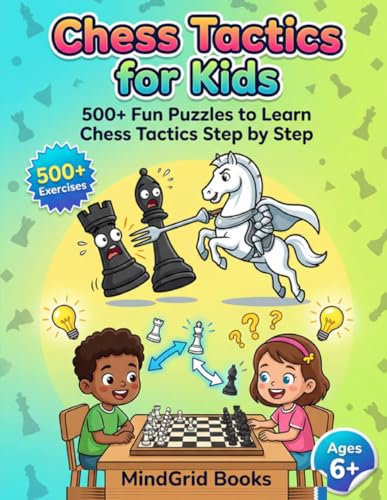
- Chess Tactics for Kids is a 504-puzzle book from real games, six large diagrams to a page and three rated sections that get harder as the child improves.
Short, regular sessions suit children better than a single long one, and playing a game afterwards helps the patterns stick. For approximate ages, which puzzle types to start with and how parents can help, see chess puzzles for kids: what age should children start?
What should you do next?
Pick the step that matches where you are:
- Not sure the tactics are clear yet? Print the ten free chess puzzles for kids. They cover mate in one, forks, pins and hanging pieces, and they are useful for adults who want a gentle first set too.
- Ready for a larger set to drill? 1000+ Chess Puzzles for Beginners has 1,008 puzzles in two graded sections, nothing longer than two moves and twelve diagrams to a page, and every position comes from a real game.
- Working with a younger player? Chess Tactics for Kids uses larger diagrams, six to a page, and runs from beginner to club level.
Whichever you choose, keep the routine from above: solve first, check the answer, return to the ones you missed, and play games in between.
Questions beginners ask about chess tactics
What should I learn first: forks, pins or mate in one?
Hanging pieces and mate in one come first, because they win something straight away and need the least calculation. Forks come next, then pins and skewers. Discovered attacks and double checks are easier once you are comfortable reading lines.
How are tactics different from strategy?
A tactic is a short forcing sequence that gains something now. Strategy is the longer-term planning, such as piece placement and pawn structure, that sets up or prevents tactics. At beginner level a missed tactic often decides a game before a poor plan does, so tactics are a common place to start.
Do I need to know chess notation to practise tactics?
No. It is helpful to learn it eventually, because puzzle answers, books and apps use it, but a puzzle can be solved by looking at the diagram and moving the pieces. Good puzzle pages explain each answer in words as well as notation.
Are puzzles enough to improve at chess?
They train one skill, spotting tactics, and they do it well. Playing games trains the rest: choosing a plan, handling openings and finishing endgames. Most players do best with a mix.
Is it better to solve puzzles on a board or on paper?
On a board while you are learning, because setting up the position makes it concrete and lets you test a different move. On paper once diagrams are easy to read, because it trains you to see moves without touching the pieces.