Most children can start chess puzzles once they know how every piece moves and can tell what checkmate is. For many that happens somewhere around six or seven, for others a year or two later, and a child who is ready earlier or later is quite normal. Readiness depends on the child more than on a birthday. If a child can set up the board, move each piece correctly and play a simple game to the end, they can try a first puzzle.
This page is for parents and teachers choosing puzzles for a child: what to start with at different ages, how long a session should be, how to help without giving the answer away, and what to avoid. The ages are approximate, because children vary a great deal, and nothing here is a test of ability.
What age can kids start chess puzzles?
There is no official age. The practical requirement is knowledge, not age:
- the child knows how each piece moves, including castling, en passant and promotion if they have come across them;
- they know that a king in check must be rescued, and what checkmate looks like;
- they can read a board diagram, or use a real board to set up the position.
If a child is still learning the moves, play and short games help more than puzzles. Moving the pieces around, playing against an adult, and winning or losing small fights all build the familiarity that puzzles depend on. When a child can play a legal game without help, a puzzle will make sense to them.
What suits children aged 5 to 7?
Roughly, this is the age for the simplest puzzles, and the main aim is for the puzzle to be a short, finishable success.
- Start with one-move puzzles. "Can you take the piece nobody is guarding?" and "Can you give checkmate in one move?" are about as much as most children of this age need.
- Use a real board. Setting up a position and trying the move on the pieces makes it concrete in a way a flat diagram does not yet.
- Keep it short. A few minutes, then back to playing a game, is plenty.
- Expect to repeat. Doing the same kind of puzzle again, on different positions, is what makes the shape familiar.
Many children in this range are still working out which side is to move and which way the pieces face, so choose puzzles that say whose turn it is.
What suits children aged 8 to 10?
Many children in this range can start recognising the basic tactics by name and can hold a short sequence in their head.
- Add forks and pins to hanging pieces and mate in one.
- Allow two-move puzzles once one-move puzzles are comfortable. The first move is a threat or a check, the opponent has to answer, and the second move wins.
- Move from the board to the page gradually. Solving from a diagram trains seeing moves without touching the pieces, but a child can go back to the board whenever a position is unclear.
- Introduce notation if they are interested. It is not required, but a child who wants to read chess books will use it sooner or later.
This is also a good stage to connect puzzles with games: after a game, look together for any moment where a puzzle pattern appeared.
What suits children aged 11 and over?
Older children can usually work with the same material as a beginner adult, with more patience for longer sessions.
- Mix the patterns instead of working through one at a time, so they learn to identify which tactic is on the board.
- Add skewers and discovered attacks, which depend on seeing pieces that line up.
- Work towards harder, rated puzzles. A graded set where difficulty rises slowly lets a child see their progress without being thrown into positions they cannot yet read.
- Look for the opponent's threats too. Asking what the other side is trying to do is a habit worth building early.
If an older child is new to chess, the beginner order is the same as for a younger one: the moves first, then one-move puzzles, then the patterns.
Which puzzle types work best, and in what order?
The order that tends to work well follows how much a child has to see. Each step adds one more thing to look for.
Hanging pieces
A hanging piece is one that nothing protects. Taking it is free material, and spotting it is the single most useful habit for a young player, because loose pieces are a common way for young players to lose a game. The habit to build is to count the guards before capturing: if a piece is protected, taking it may be a fair trade or a loss.
Black to move
Black: king g8, bishop b7, pawn f7, pawn g7, pawn h6.
Black to move: the knight on e4 sits on the bishop's long diagonal and no white piece guards it, so the bishop takes it. This diagram also shows a second idea that older beginners enjoy: the pawn on h6 gives the black king an escape square, so White's rook check on d8 would not be mate after the capture.
Mate in one
A move that gives checkmate. It combines everything a child knows: where the king can go, which pieces give check, and whether the check can be answered. It is also immediately satisfying, which matters when you want a child to keep going. There is more on finding these in mate-in-one chess puzzles for beginners.
Forks
One move that attacks two pieces. A fork is easy to explain ("it attacks two things, so they can only save one") and easy to recognise on a diagram, which is why it is usually the first real tactic children learn. Knights are the favourite because their jump is hard to see coming.
Pins
An attack on a piece that cannot move without exposing something more valuable behind it. Pins need a little more understanding, because the child has to see two pieces on the same line, so they usually come after forks.
Skewers
A pin in reverse: the more valuable piece is in front, and when it moves out of the way, the piece behind is lost. Skewers are best left until pins are comfortable, so the two are not confused.
For a longer explanation of how forks, pins and skewers differ, the page on forks, pins and skewers for beginners works through each with examples that suit a parent who is learning alongside a child.
How long should a chess puzzle session be?
Short and regular generally works better than long and occasional. A reasonable starting point is five to fifteen minutes, a few times a week, adjusted to the child's age and mood. Younger children tend to need the shorter end.
Stop when the child is tired or frustrated, ideally while they are still enjoying it. A session that ends on a puzzle they solved is a better start to the next one than a long session that ends in tears. Following a few puzzles with a game of chess is a natural way to finish, because it gives the patterns somewhere to show up.
How can parents help without giving the answer?
You do not need to be good at chess. These questions work whatever your level:
- "Whose move is it?" Many missed puzzles come from misreading the side to move.
- "Which of their pieces is not protected?"
- "What are all the checks you can make? What are all the captures?"
- "What would they do next if you did nothing?"
- "Where could the king go?" for mate-in-one puzzles.
If the child is stuck, narrow the search rather than naming the move: "look at the knight" is a hint, and "play Nc7" is the answer. When they do solve it, ask them to explain why the move works. A child who can say "it attacks two things" has learned the pattern, not only the answer.
If they find a different move from the one printed, set up the position and play it out together. Either it also works, which is worth knowing, or the other side has a reply that shows why it falls short, which teaches more than the printed answer.
What mistakes do parents and children make with chess puzzles?
- Starting too hard. A child who fails five puzzles in a row learns that puzzles are not for them. Go back to easier ones until success is regular.
- Rushing. Fast guessing feels productive and teaches little. A moment of looking at all the checks and captures is the skill.
- Skipping the label. Puzzles say whose turn it is. A puzzle solved for the wrong side is a different puzzle.
- Doing puzzles instead of playing. Puzzles teach the patterns; games are where the child has to notice them unprompted. Use both.
- Treating the answer as the point. Remembering one position teaches that position. Asking what made it work is what carries over to the next game.
- Comparing children. A child who needs more time on one-move puzzles is not behind; they are practising at their own pace.
Where can children find chess puzzles to practise?
You can start free. Ten free printable chess puzzles for kids cover mate in one, forks, pins and hanging pieces, with a label for whose move it is, a list of every piece and its square, and each answer explained in words. They need no notation and no signup.
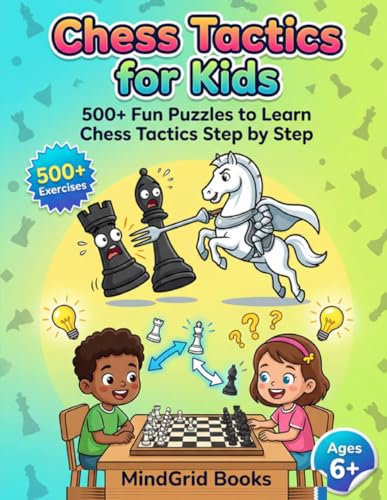
For a larger supply, Chess Tactics for Kids is a 504-puzzle workbook with six large diagrams to a page, built from real games and arranged in three rated sections so the difficulty rises gradually, with full solutions at the back. It opens with one-move puzzles, including mate in one, before it moves to two-move combinations. Older children and adult beginners can use 1000+ Chess Puzzles for Beginners, which has 1,008 puzzles at twelve smaller diagrams to a page.
The broader overview of tactics, including how to calculate and practise, is in the chess tactics guide for beginners, which is written for the adult learning alongside the child as much as for the child.
Questions parents ask about chess puzzles
Is chess too hard for a five-year-old?
Some five-year-olds enjoy it, and many are not ready yet. If a child is interested, learn the moves through play and keep it short. If they are not, leave it for a while; there is no rush.
Do kids need to know chess notation first?
No. A clear diagram and an answer explained in words are enough to start. Notation is useful later for reading books and using apps, and puzzle answers are a gentle way to pick it up.
Are puzzles or games better for learning chess?
They do different jobs. A puzzle isolates one pattern until it becomes quick to spot. A game is where a child has to notice it with nobody saying it is there. Most children do best with a mixture.
Should a child solve puzzles on a board or on paper?
On a board at first, because setting up the position makes it concrete and lets them test another move. On paper once diagrams are easy to read, because it builds the ability to see moves without moving anything.
How many puzzles should a child do in one go?
A handful. Quality of attention matters more than quantity, and a few puzzles finished with thought are worth more than a page of guesses.