Group world flags by shared design instead of drilling them individually. Many flags borrow from neighbours or allies: the Nordic cross, the pan-Arab, pan-African and pan-Slavic colours, the star and crescent, the Union Jack, the Southern Cross and the tricolours. With those patterns in place, even an unfamiliar flag points to a region. Then add the famous exceptions, the look-alike pairs, and a map.
The usual way to teach flags is a stack of cards: show the flag, say the country, repeat until it sticks. It works, slowly, for as long as the drilling continues, and much of it fades once the drilling stops.
There is a much better approach, and it starts from a fact that flashcards hide: flags are not two hundred unrelated pictures. They fall into families. Countries copied their neighbours, borrowed from allies, and adopted shared colours on purpose. Learn eight or so families and a child can look at a flag they have genuinely never seen and say something true about it.
That last part is what makes it stick. Recognition is a memory task. Deduction is a game.
What are the main flag families?
Eight families are worth teaching. Start with the Nordic cross, the easiest, and leave the tricolours, the biggest, until last:
| Family | What to look for | Examples |
|---|---|---|
| Nordic cross | a cross on its side, upright shifted towards the flagpole | Denmark, Sweden, Norway, Finland, Iceland |
| Pan-Arab colours | red, white, green and black | Jordan, Kuwait, United Arab Emirates, Sudan, Iraq |
| Pan-African colours | green, yellow and red | Ethiopia, Ghana, Senegal, Mali, Cameroon |
| Pan-Slavic colours | blue, white and red | Russia, Serbia, Slovakia, Slovenia, Croatia |
| Star and crescent | a crescent moon with a star | Turkey, Tunisia, Algeria, Pakistan, Malaysia |
| Union Jack in the corner | the British flag in the upper corner by the pole | Australia, New Zealand, Fiji, Tuvalu |
| Southern Cross | the stars of the constellation | Australia, New Zealand, Papua New Guinea, Samoa, Brazil |
| Tricolours | three stripes: vertical ones usually follow France, horizontal ones often the Netherlands | Italy, Ireland, Belgium, Romania |
The Nordic cross. A cross lying on its side with the upright shifted towards the flagpole. Denmark, Sweden, Norway, Finland and Iceland all use it, and the shift is the tell — a centred cross, like Switzerland's, is something else. This is the easiest family to teach because the shape is unmistakable and five countries come free with it.
Pan-Arab colours. Red, white, green and black, first combined in the 1916 flag of the Arab Revolt. Jordan, Palestine, Kuwait, the United Arab Emirates, Sudan, Syria, Iraq, Egypt and Yemen all draw on that palette. A child who sees those four colours has a strong hint about the region before knowing the country.
Pan-African colours. Green, yellow and red — the colours of Ethiopia, which carried the meaning because it resisted colonisation. Ghana, Senegal, Mali, Guinea, Cameroon and Togo among others. There is a second pan-African set too, the red, black and green introduced by Marcus Garvey in 1920, which is worth mentioning to older children as an example of two traditions sharing one name.
Pan-Slavic colours. Blue, white and red, agreed at the Prague Slavic Congress of 1848 and taken from the Russian flag. Russia, Serbia, Slovakia, Slovenia, Croatia and Czechia. The colours are shared; the arrangement and the coats of arms are what separate them, which makes this family a good exercise in looking closely.
Star and crescent. Turkey, Tunisia, Algeria, Pakistan, Mauritania, Azerbaijan and Malaysia among them. Instantly recognisable, and a useful illustration that a symbol can travel much further than any one country.
The Union Jack in the corner. Australia, New Zealand, Fiji and Tuvalu still carry it in the upper hoist. Historically many more did, and the ones that dropped it are a whole conversation in themselves.
The Southern Cross. The constellation appears on Australia, New Zealand, Papua New Guinea, Samoa and inside the globe on Brazil's. A nice one for children because it is a thing you can actually go outside and look for, if you are in the right hemisphere.
Tricolours. The biggest family and the one to teach last, because it is enormous. The short version: vertical stripes usually descend from the French flag — Italy, Ireland, Belgium, Romania, Chad, Nigeria, Ivory Coast — and horizontal stripes often from the Dutch. Once a child knows this, "three vertical stripes" stops being a memory item and becomes a starting point.
Teach it as guessing, not recall
The whole method collapses if you turn the families into a list to memorise. Use them as the rules of a guessing game instead.
Show a flag the child has not seen. Ask what they can work out — not what country it is. Nordic cross, so probably Scandinavian. Green, yellow and red, so probably African. Blue, white and red with a shield, so probably Central or Eastern European. Then reveal the answer.
Being roughly right feels like solving something, and children will play this for far longer than they will sit through cards. The country names arrive as a by-product. The same trick works for places as well as flags: these reasoning puzzles about real places ask a child to work out an answer rather than recall it.
 Free bonus inside
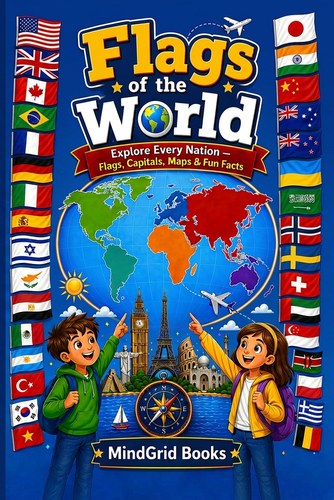
Flags of the World
All 193 UN member countries, one per page, with full-color flags, capitals, maps, quick stats and fun facts. Color-coded by continent. Free Flag Detective Activity Pack available now.
Learn more →Which flags break the pattern?
Every family has flags that break it, and children remember the breakages better than the patterns.
Nepal is the one to lead with: it is the only national flag in the world that is not a rectangle — two stacked pennants, with a moon and a sun on them. Switzerland and Vatican City are the only square ones. Paraguay's flag is different on the front and the back. Mozambique's has a rifle on it. Cyprus puts a map of itself on its own flag, and Kosovo does the same.
These are worth deliberately collecting. A child who knows six weird flags has a reason to care about the ordinary ones.
Which flags are easiest to confuse?
The families have a cost: flags in the same family can be near-identical. These five pairs are the classic mix-ups:
| Pair | How to tell them apart |
|---|---|
| Chad and Romania | They differ only in their shades, most visibly the blue |
| Indonesia and Monaco | Both are red over white; they differ in shape |
| Ireland and Côte d'Ivoire | Mirror images: Ireland has green next to the flagpole, Côte d'Ivoire orange |
| The Netherlands and Luxembourg | They differ in how light the blue is; Luxembourg's is lighter |
| Norway and Iceland | Red and blue swapped: Norway is red with a blue cross, Iceland blue with a red cross |
These pairs are worth teaching on purpose, side by side, once the families are in place. The free flag matching worksheet shows all five pairs with a one-line way to tell each apart, plus a twelve-flag matching activity with an answer key.
Pair flags with places, or they float
A flag learned by itself is a pattern with a name attached. What makes it into geography is knowing roughly where the country is and one concrete thing about it.
So when a flag is learned, find the country on a map — the actual map, not a picture of the flag — and attach a single fact. Not a statistic. Something a child would repeat to somebody else.
This is the same principle that makes American state learning work, where anchor states and strange facts beat alphabetical lists: teaching kids the 50 states sets that method out, and it transfers directly to countries. For the map half, the free geography quiz for kids includes a continents-and-oceans map round.
Where books help and where they do not
A flag book's job is to be the reference the guessing game runs on, and to have the flags large enough and accurate enough to actually compare.
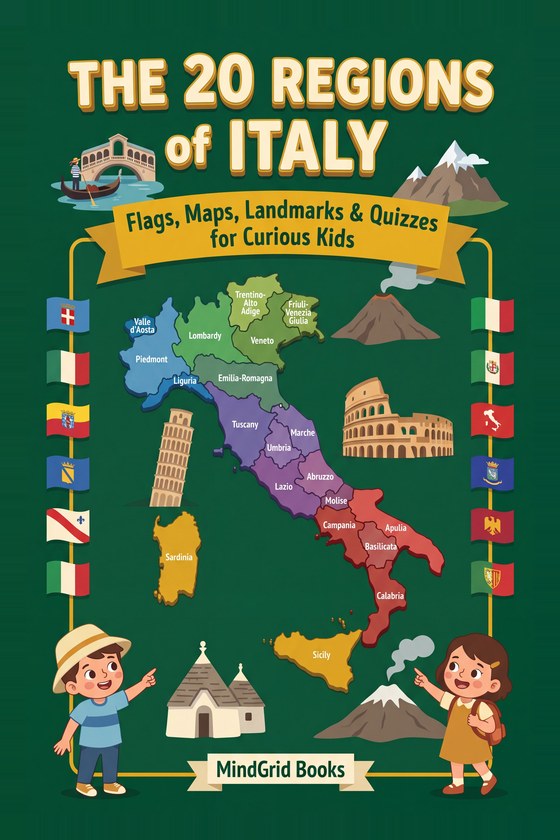
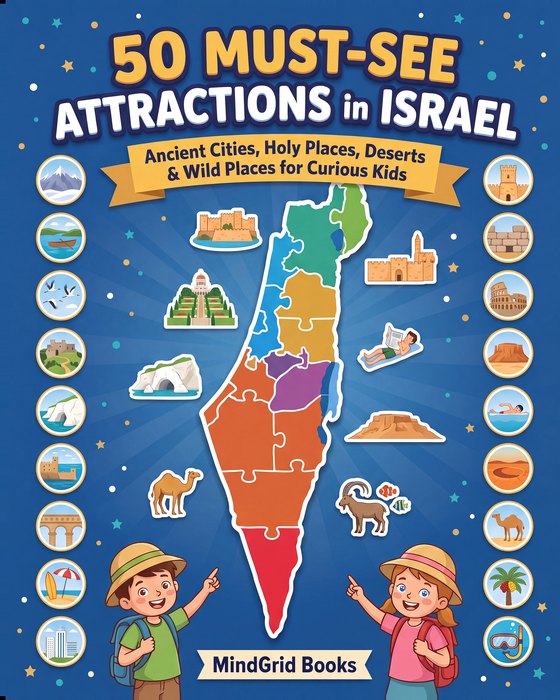
Flags of the World is our flag book for children, built around recognising and comparing flags rather than drilling them. For the map half of the work, The 50 States of America covers the United States state by state, and our Geography Facts for Kids series goes country by country — The 20 Regions of Italy and 50 Must-See Attractions in Israel take a single country and give it the depth a world atlas cannot.
If you are deciding what kind of book you need at all, how to choose geography books for kids breaks down the four kinds and what changes between ages four and twelve.
Frequently asked questions
How many flags are there in the world?
There are 193 member states of the United Nations, each with its own national flag, plus two observer states, Vatican City and Palestine. Many territories and regions fly flags of their own as well.
What age can children start learning flags?
Recognising a few bright, distinctive flags is something many preschoolers enjoy. The family method works once a child can compare two designs and say what is different, so start it when that comes easily.
Are flashcards a bad way to learn flags?
Not bad, just slow as a first step, because each flag is memorised as a separate picture. They work well later, for checking which flags have stuck.
What is the study of flags called?
Vexillology. The word comes from the Latin vexillum, a kind of flag carried by Roman soldiers.
Key takeaways
Do not teach two hundred flags. Teach eight families, a handful of glorious exceptions, and the habit of guessing before checking — because a method survives the summer holidays.
- Many flags belong to families: the Nordic cross, pan-Arab, pan-African and pan-Slavic colours, star and crescent, Union Jack, Southern Cross and tricolours.
- Play it as a guessing game: ask what an unfamiliar flag suggests before revealing the country.
- Collect the exceptions: Nepal's flag is the only national flag that is not a rectangle, Switzerland's and Vatican City's are square, and Paraguay's differs front and back.
- Teach the look-alike pairs side by side once the families are in place.
- Find each country on a map and attach one fact, or the flag stays a picture with a name.