Teach the 50 states in this order: a handful of anchor states the child already knows, then one region at a time, then the distinctive shapes, then one memorable fact per state, and capitals last, as a separate step. Practise by recall, with blank maps and quick quizzes, rather than by re-reading. At a region a week, fifteen minutes at a time, that takes about two months.
There is a version of this that almost every child goes through: the alphabetical list, the song, the placemat with all fifty names on it. It produces a child who can recite fifty words in order and cannot point at Missouri.
That is not a failure of effort. It is a failure of ordering. Alphabetical is the one sequence that guarantees each state is next to states it has nothing in common with — Alabama, Alaska, Arizona, Arkansas covers the deep south, the Arctic, the desert and the Ozarks in four steps. Nothing reinforces anything.
Here is a sequence that works better.
What order should kids learn the 50 states in?
Six steps, each one secure before the next starts. Recall practice runs alongside all of them.
| Step | Focus | Ready for the next step when |
|---|---|---|
| 1. Anchors | 6–8 states the child already knows or cares about | They can find every anchor on a blank map without hesitating |
| 2. Regions | One region at a time, completely | The whole region is secure on a blank map |
| 3. Shapes | The distinctive shapes first, then the rectangles by position | The distinctive shapes are recognised on sight |
| 4. One fact per state | A single fact worth repeating to a friend | Each state in the region has its hook |
| 5. Capitals | Capitals as a separate set, region by region | Last step; start only once the states are secure |
| 6. Recall | Blank maps, quizzes, name-three games | Runs alongside every step |
1. Start with the anchors, not the list
Before any systematic coverage, a child needs a handful of states they know cold. Six to eight is enough. Pick them for the child, not for the map:
- the state you live in
- states where family live
- states they have visited
- states attached to something they already care about — a team, a film, a theme park, a song
These become reference points. Every state learned afterwards gets attached to one of them: "north of Texas", "the one above California". Without anchors, every new state is free-floating and has to be memorised on its own.
Do not move on until they can find the anchors on a blank map without hesitating.
2. Learn regions, not states
Fifty separate items is beyond what anyone memorises comfortably. Five or six groups of eight to twelve is very manageable, and the grouping does most of the work by itself.
New England. The Mid-Atlantic. The South. The Midwest. The Mountain West. The Pacific. The exact boundaries are arguable and it does not matter — what matters is that the child stops seeing fifty things and starts seeing six neighbourhoods.
The payoff is retrieval. A child asked "where is Vermont?" who has learned alphabetically has to search fifty items. A child who has learned by region recalls "New England — the small ones in the top right corner" and is most of the way there.
Cover one region at a time, completely, before starting the next. 50 States by Region lists which states belong to each.
 Free bonus inside
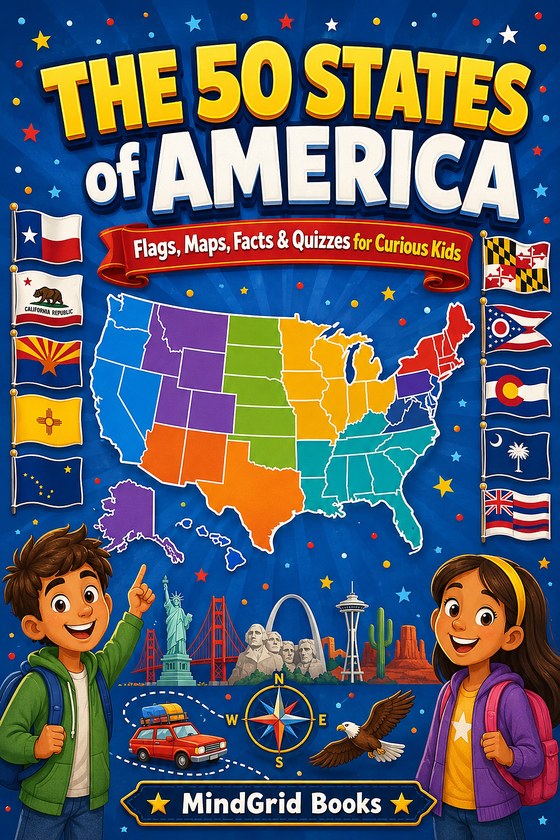
The 50 States of America
A full-color atlas for kids ages 8-12. Every state gets its own page: flag, map, state shape, capital, nickname and three facts, plus eight region quizzes. Free 50-States Quiz Challenge available now.
Learn more →3. Shapes before names
This one is underused and works remarkably well, especially for younger children.
Some states have shapes that are impossible to confuse: Florida, Texas, California, Michigan, Louisiana, Oklahoma, Idaho. Learn these as shapes first, without worrying about names or capitals. It turns the map from a wall of text into a set of recognisable objects — closer to learning animals than to learning a list.
The rectangular states in the middle are genuinely hard and always will be. Leave them until the distinctive ones are secure, then learn them by position relative to the shapes already known. Wyoming and Colorado are two rectangles stacked above each other, and the only reliable way to tell them apart is that Colorado touches the pointy bit of Oklahoma.
4. One fact per state — and make it a strange one
This is the step that converts recognition into memory.
Each state gets exactly one fact, and the fact has to be worth repeating to somebody else. Not the state bird. Not the year it joined the union. Something a child would actually interrupt an adult to say.
The test is simple: if the child would not tell a friend about it, it will not be remembered. Population figures and admission dates fail this test almost without exception. A weird law, an enormous animal, an unexpected record, a thing that happened there — these survive.
One fact, firmly attached, does more than five facts loosely attached. And once a state has a hook, its name, shape and position tend to arrive with it rather than needing separate work. 50 States Facts for Kids has fifteen to start with.
5. Capitals last, and separately
Capitals are a second set of fifty items, and treating them as part of the first set roughly doubles the difficulty at exactly the wrong moment.
Wait until the states themselves are secure. Then note the thing that makes capitals easier: in most states the capital is not the famous city. Not New York City, not Los Angeles, not Chicago, not Houston. Once a child notices that the pattern is "the one you have not heard of", capitals become much less arbitrary.
The exceptions — Boston, Denver, Atlanta, Phoenix — are then worth learning as exceptions, which is easier than learning them as fifty unrelated pairs. The full list of 50 states and capitals is set out for learning region by region.
6. Recall, not review
Re-reading a page of states feels like learning and mostly is not. The thing that builds durable memory is retrieval: producing the answer from nothing.
Practical versions that take under five minutes:
- Blank map, name what you can. Once a week. The point is the gaps.
- Let them quiz you. They hold the book, you answer, they mark it. Being the examiner requires knowing the material and children love it.
- Name-three. "Three states touching the Pacific." "Three in New England." Forces the region structure to be used rather than just recognised.
- The car version. Licence plates, road signs, weather reports. Any state encountered in the wild gets located on the mental map immediately.
Short and frequent beats long and occasional, by a wide margin.
For the blank-map version there is a free printable: the 50 states map quiz has a numbered outline map with Alaska and Hawaii in insets, fifty answer lines, two ten-state capitals matching sets and a test of all fifty capitals for when you reach step 5, and a complete answer key on a separate page. Use it the way this section describes — once a week, and treat the blanks as next week's lesson rather than as a score. For a shorter plan focused on memorising states and capitals together, see how to memorize the 50 states and capitals.
What doesn't work when teaching the 50 states?
The song as a teaching tool, learning all fifty at once, testing before teaching, and correcting immediately.
The song, as a teaching tool. It is a fine thing to know and it teaches no geography — the order is alphabetical, so it reinforces nothing about where anything is. Enjoy it; do not count it as progress.
Learning all fifty at once. Region by region, always.
Testing before teaching. A blank map handed to a child who has not learned the anchors yet produces discouragement, not a baseline.
Correcting immediately. When they place a state wrongly, ask which states touch it. They will usually find the error themselves, and self-correction sticks in a way that being told does not.
How long does it take to learn the 50 states?
Slower than most guides suggest and faster than most parents fear. A region a week, fifteen minutes at a time, puts a child through all fifty states in about two months with the facts attached — and, more importantly, leaves them with a structure they can hang new places on for the rest of their life.
The fifty states are not really the goal. The habit of asking "where is that, and what is it next to?" is. It works just as well for countries: how to teach kids world flags applies the same idea to the rest of the world.
Frequently asked questions
How many states are there in the United States?
Fifty. The last two to join were Alaska and Hawaii, both in 1959. Washington, D.C. is a federal district, not a state.
How many regions of the U.S. are there?
There is no single official answer for teaching. The U.S. Census Bureau uses four (Northeast, Midwest, South and West), while many teaching materials use five or six. Pick one system and keep to it.
What is the best age to learn the 50 states?
There is no single right age. Anchors and distinctive shapes work with young children; the full fifty with capitals is a bigger job, better started once a child is comfortable reading a map.
What should kids learn after the 50 states?
Capitals, if they are not done yet, then abbreviations, major rivers and mountain ranges, and landmarks, one layer at a time. US geography for kids sets out a sequence.
Key takeaways
- Start with six to eight anchor states the child already cares about, and make sure they can find them on a blank map.
- Learn five or six regions, one at a time, instead of fifty separate states.
- Learn the distinctive shapes, such as Florida, Texas, California and Michigan, before the rectangular states in the middle.
- Give each state one fact worth repeating, and add capitals last, as a separate step.
- Short, frequent recall beats re-reading. A region a week, fifteen minutes at a time, covers all fifty in about two months.