These are printable 9x9 Sudoku puzzles with one puzzle on every page, so the grid fills the sheet. Each grid is 6.5 inches wide, the numbers are big and bold, and every square has room for a pencil mark. There are twelve Easy puzzles and eight Medium ones, with the answers in a separate file. The downloads are free and need no email address.
Download the free PDFs
All three files are US Letter, black and white, and light on ink: plain white
squares, thick lines around the 3 x 3 boxes and no pictures or adverts anywhere
near the puzzle. Every sheet has an ID such as LP-E01 (Easy) or LP-M01
(Medium), and the answer key lists the same IDs in the same order.
Easy: 12 puzzles
One puzzle to a page. Every one can be finished by writing in the only number a square can take, or the only square a number fits.
Medium: 8 puzzles
One puzzle to a page. Each needs one extra idea on top of the Easy ones, explained below.
Answer key
Solutions to all 20 puzzles in a separate file, listed by puzzle ID, so a solver can finish before anyone checks.
Easy or Medium?
If you have not done a Sudoku for a while, start with Easy and work through the sheets in order: they are arranged so that each one asks a little more than the one before. Both levels are defined by what a solver has to do, not by how many numbers are printed. Medium sheets sometimes have almost as many starting numbers as the last Easy ones; what changes is the kind of step needed.
| Level | What the solver does | Puzzles | Starting numbers |
|---|---|---|---|
| Easy | Only two ideas are needed: a square where just one number is possible, and a number that has just one place left in a row, column or box. Puzzles LP-E01 to LP-E04 need only the first idea. | LP-E01 to LP-E12 | 32 to 44 |
| Medium | The same two ideas, plus at least once a step that crosses out possibilities before the next number can be written: a number locked into a line (idea 4) or a naked pair (idea 5). Both are explained, with an example, below. | LP-M01 to LP-M08 | 27 to 33 |
Every puzzle has exactly one answer and can be finished by reasoning alone. If a Medium puzzle feels too much, going back to an Easy one is perfectly normal. For more on how Sudoku levels are judged, see what each Sudoku difficulty level means.
How to solve a 9x9 Sudoku
The grid has nine rows, nine columns and nine boxes of 3 x 3 squares, marked by the thick lines. Write a number from 1 to 9 in every empty square so that each row, each column and each box contains all nine numbers exactly once. You never add or calculate anything: the numbers are only labels.
- Look for a square with only one possible number. Pick an empty square and read along its row, down its column and around its box. Cross off every number you can see. If eight are crossed off, the ninth goes in the square. This is the only idea the first four Easy puzzles need.
- Look for a number with only one place to go. Choose a number, such as 7, and look at one box. Wherever a 7 already sits in a row or column, no other 7 can go in that row or column. If only one empty square in the box is left, the 7 belongs there.
- Repeat. Each number you write in changes what its row, column and box can hold, so a square that was stuck a minute ago often becomes easy.
- Never guess. If you cannot find a step, look again at a different row, column or box. Every puzzle in these PDFs can be finished by logic. The Easy puzzles can be finished with ideas 1 to 3. If you get stuck on a Medium puzzle, the next section has two more ideas.
When the Easy ideas run out: Medium puzzles
Every Medium puzzle reaches a point where no square has just one possible number and no number has just one place left. You are not stuck for good. You need to cross out some possibilities first, so that an Easy idea works again. Two ways to do that are enough for these puzzles. Both work best if you pencil in the possible numbers of the empty squares in small figures in the corner.
Below, squares are named by row and column, counting rows from the top and columns from the left, and the nine boxes are numbered 1 to 9 from left to right, top to bottom. Each example is taken from one of the Medium puzzles, so you can find the same squares on that sheet. First write in the numbers that the Easy ideas give; the boards below show those in green.
Idea 4: a number locked into a line (locked candidates)
If, inside one box, a number can only go in squares that all lie in one row (or one column), then that row (or column) gets its number from the box. So the number can be crossed out everywhere else in that row (or column). The same works the other way round: if, in one row or column, a number can only go in squares that are all in one box, it can be crossed out in the rest of that box.
Worked example: locked candidates, in puzzle LP-M02
Fill in every number that the Easy ideas give you. In puzzle LP-M02 that is 15 numbers, and then you are stuck: no square has just one possible number, and no number has just one place left. The board looks like this.
Look at box 8 (the bottom middle box). In that box the 1 can go in only two squares: (row 8, column 4) and (row 8, column 5). They are all in row 8. So the 1 of box 8 must be somewhere in row 8, which means no other square in row 8 can be a 1. Cross out the 1 as a possibility in (row 8, column 1).
That crossing-out did not write a number by itself. But (row 8, column 1) could be 1 and 5 before, and now it can only be a 5, so you can write the 5 there (the square is highlighted in the grid).
Idea 5: two squares with the same two possibilities (naked pair)
If two squares in the same row, column or box can each only be the same two numbers, those two numbers are used up by them, in some order. So neither number can go anywhere else in that row, column or box, and it can be crossed out there.
Worked example: a naked pair, in puzzle LP-M08
Start again from the board you get after the Easy ideas have written in everything they can. In puzzle LP-M08 that is 23 numbers.
Look at box 9 (the bottom right box). Pencil in what each empty square could be. The square (row 8, column 8) can only be a 2 or a 9, and so can the square (row 9, column 9). Two squares share the same two possibilities, so between them they hold a 2 and a 9, in one order or the other (you cannot tell which yet). So no other square in box 9 can be a 2 or a 9. Cross out the 2 in (row 7, column 7), (row 7, column 8) and (row 7, column 9), and the 9 in (row 7, column 8) and (row 7, column 9).
Nothing is written yet: a naked pair only removes pencil marks. The squares it clears often become easy to finish afterwards.
After either idea, go back to ideas 1 to 3. Crossing out a possibility often leaves a square with only one number, or a number with only one place, and the puzzle starts moving again. Neither idea needs guessing: each cross-out is certain, because the number it removes could never be the answer there.
Printing at actual size
- Print on US Letter (8.5 x 11 inch) paper and choose Actual size or 100%, not "Fit to page", so the grid prints 6.5 inches wide. On A4 paper "Fit" is the right choice, and the grid becomes slightly smaller.
- Use plain white paper and a soft pencil (2B is easier to read than HB) or a dark pen. Print in black and white; nothing needs colour.
- To print one puzzle, choose its page number in the print dialog instead of printing the whole file.
- Print the answer key separately, or keep it on the screen, so the solver can finish before checking.
- If a printer sheet comes out faint, increase the print quality or darkness setting rather than enlarging the grid.
Tips for beginners and for anyone helping
- Pencil first. A small mark in the corner of a square is a good way to keep track of the numbers it could be. The squares are big enough to hold them.
- Start with the fullest row, column or box. The fewer blanks it has, the fewer numbers need to be considered.
- Work in short sessions. One puzzle is plenty for a sitting. Stop at a clear point and come back to the page later.
- Ask, don't tell. If you are helping someone, try "which numbers can you see in this row?" before pointing at a square.
- In a group or care setting, print several copies of the same sheet and compare how each person got to the answer, or hand out different IDs so that nobody feels they are racing.
- Check by rule, not only by key. A finished grid is right when every row, column and box contains 1 to 9 once.
If you want a whole book of these
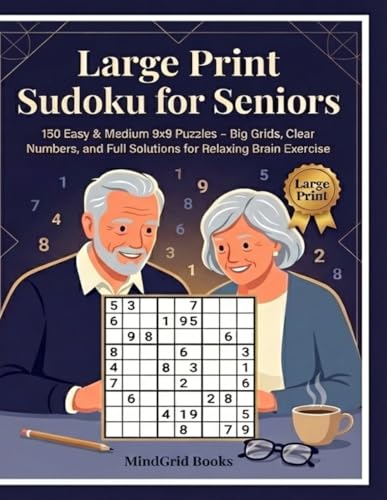
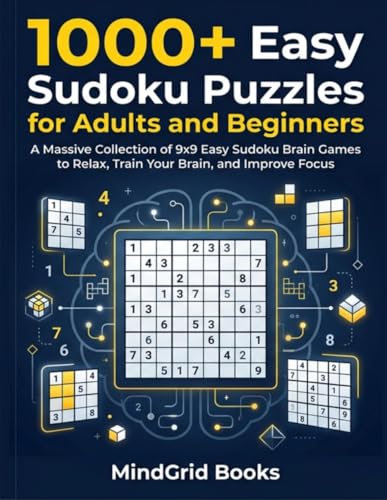
The free sheets run out after twenty puzzles. Our paperback Large Print Sudoku for Seniors has 150 classic 9x9 puzzles, 75 Easy and 75 Medium, two to a page on 8.5 x 11 inch pages, with solutions at the back. The book's page lists its other details. The puzzles in the book are different from these free sheets. If you would like to look at more than one title, all of our Sudoku books are compared on one page, including 1000+ Easy Sudoku Puzzles for those who prefer a thicker collection of beginner puzzles.
If younger family members would like to join in, there are separate printable Sudoku puzzles for kids in 4x4 and 6x6 sizes, and more worksheets on the free printables page.
How the puzzles were made and checked
The twenty puzzles are original. A program generated them from a fixed starting value, and a second program re-checked every one before it was published: each has exactly one solution, each can be solved by the techniques its level names without guessing, and none is a rotated, relabelled or rearranged copy of another or of a practice puzzle elsewhere on this site. The starting numbers in each grid are laid out symmetrically. The PDFs are rebuilt from the same data, so a puzzle and its answer cannot drift apart. The sheets are meant for personal, family, care-home activity and classroom use; please do not resell them.