The best U.S. geography book for a child is not necessarily the one with the most facts. For ages 8-12, a useful book needs to help a reader answer four basic questions: Where is the state? What is it near? What makes it memorable? Can I test myself afterward?
Look for maps that do real work
A decorative map is not enough. Kids need maps that make state position, neighbors, regions and major physical features easy to see.
For younger readers especially, the map should be readable without a dense legend or tiny labels.
State-by-state structure is easier to revisit
A book that gives each state its own page or spread is easy to use in short sessions. A child can study one state, return later and still understand where they left off.
This structure also works well for homeschool lessons because a parent can assign a small, predictable amount at a time.
Facts should be memorable, not just numerous
Capitals, abbreviations and statehood dates matter, but a page made only of reference facts is hard to remember.
Good geography books mix essential information with distinctive details: landmarks, records, unusual history, landscapes and regional connections.
For examples of the kind of facts that work as memory hooks, see 50 States Facts for Kids.
Quizzes improve retention
A child who only rereads information can mistake familiarity for knowledge. Quizzes force retrieval.
Look for region quizzes, map labeling, matching activities or question sets that require the learner to produce an answer rather than simply recognize it.
 Free bonus inside
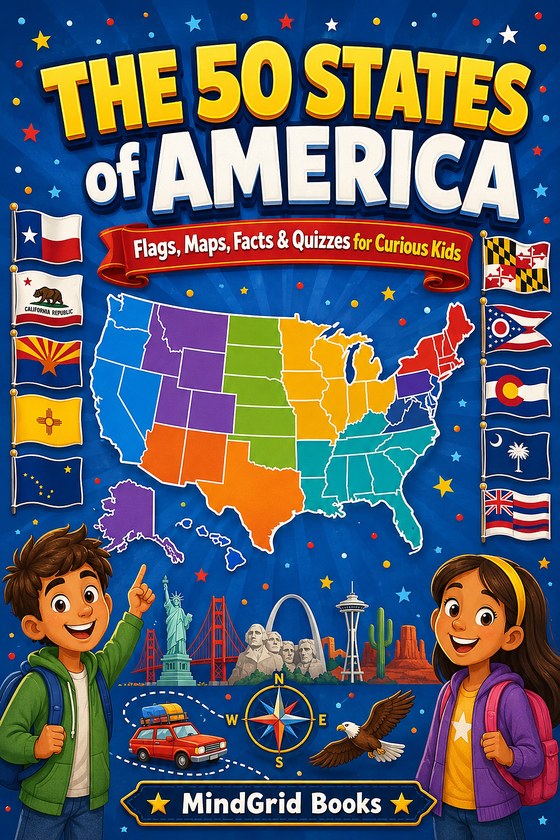
The 50 States of America
A full-color atlas for kids ages 8-12. Every state gets its own page: flag, map, state shape, capital, nickname and three facts, plus eight region quizzes. Free 50-States Quiz Challenge available now.
Learn more →Atlas-style vs fact-and-trivia style
These formats serve slightly different purposes.
An atlas-style book is strongest for location, maps, state shapes, flags and visual geography.
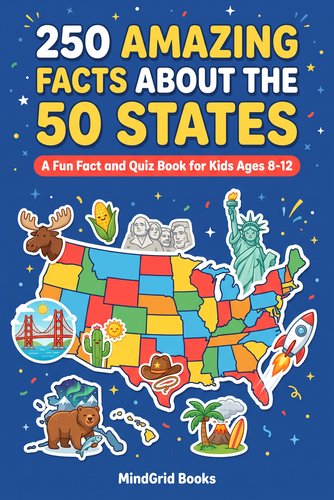
A fact-and-trivia book is stronger for memorable details, conversation, reading aloud and quiz-based learning.
Many kids benefit from using both: map first, memorable facts second.
 Free bonus inside
250 Amazing Facts About the 50 States
A fun fact and quiz book for kids ages 8-12. All 50 states across 8 regions, plus 80 quiz questions with answer keys. Free Family Trivia Night Pack included.
Learn more →What works well for homeschool
For homeschool use, look for resources that can support repeated short lessons rather than one long reading session. Useful features include:
- clear regional organization;
- maps and state shapes;
- capitals and abbreviations;
- short facts that can be narrated back;
- quizzes with answer keys;
- printable companion activities.
A free blank-map exercise can extend a book significantly. See the 50 States Map Quiz.
Avoid books that overwhelm the page
More information is not always better. Dense pages full of tiny text, statistics and sidebars make it difficult for a child to know what matters.
A strong page has hierarchy: state name, map, a few core facts and one or two memorable details.
Match the book to the child's goal
If the goal is learning locations, choose a visual atlas.
If the goal is remembering interesting things about every state, choose a facts-and-trivia format.
If the goal is school or homeschool review, prioritize quizzes, answer keys and regional organization.
If the goal is family reading, shorter facts and question formats work better than textbook-style chapters.
Build a full learning sequence
Books work best as part of a simple sequence:
- Learn the states visually.
- Group them by region.
- Add capitals.
- Attach memorable facts.
- Test with a blank map and quizzes.
For the broader sequence, see US Geography for Kids: What to Learn First.